Large Signal Model · Plate 12 of 17

A curved domain can have a finite witness

A matrix embedding changes the certificate language.

Question to keep in view. How can a curved domain have a finite matrix certificate?

Resources & source

Original PDF page · Atlas source

Skip contents and start reading

The Lorentz cone and its normalized disk admit the representation
\[ C=\{(m,x,y):m\geq\sqrt{x^2+y^2}\},\qquad J(m,x,y)=\frac12\begin{pmatrix}m+x&y\\y&m-x\end{pmatrix}. \]
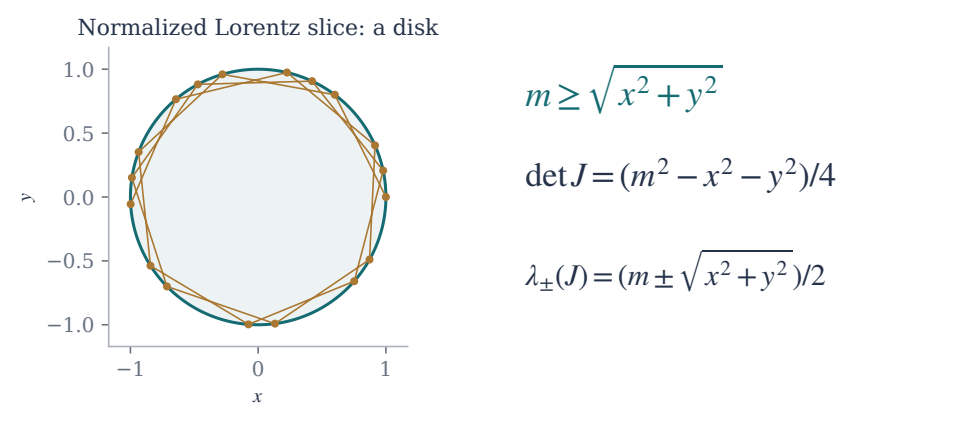
A finite orbit in a normalized disk, with the corresponding positive-semidefinite matrix certificate.
Read the diagram in words

The disk is the normalized slice of the curved Lorentz cone. The matrix representation translates cone membership into positive semidefiniteness. The finite drawn orbit illustrates the rotation; its density and the obstruction to finite generators come from the written proofs, rather than the plotted points.

Since the eigenvalues of \(J\) are \((m\pm\sqrt{x^2+y^2})/2\), membership in \(C\) is equivalent to \(J\succeq0\). Also \(\operatorname{tr}J=m\).

For the exact spatial rotation \(R=\bigl(\begin{smallmatrix}3/5&-4/5\\4/5&3/5\end{smallmatrix}\bigr)\) and \(T={\operatorname{diag}}(1,R)\),

\[ J(Tz)=\frac15WJ(z)W^{\mathsf T},\qquad W=\begin{pmatrix}2&-1\\1&2\end{pmatrix}. \]

The mathematical point

A rational congruence identity certifies the unchanged rotation on the curved cone. In the full P46 model, the canonical domain has no finite normalized positive-generator certificate.

Scope

The drawn orbit is finite. Density and the finite-generator obstruction are proved in the volume, not established by its plotted points. The full instrument also needs its observation, mass and initial-state identities. No quantum implementation is asserted.

Formal route

RotationP46.lean; MatrixEmbedding.lean; MatrixRotation.lean.

Follow the proofs

Inspect the mapped Lean modules
Source and reading aids

The atlas text, mathematics, plate order, and original diagrams are retained. Questions, diagram descriptions, navigation, and the bounded comparison explorer are web reading aids. No original TeX build or Lean execution is added.

Source identities and conversion checks

Notation in Large Signal Model

Look up a symbol without leaving this chapter. Select text before opening help to search for it.

Search this work’s notation.

    Symbols can have different meanings in different passages. Read each result in its own context.

    Open the full notation index