
Three exact finite models
On this page · Permalink · Source line 1
A seed remembers multiplicity support
On this page · Permalink · Source line 2
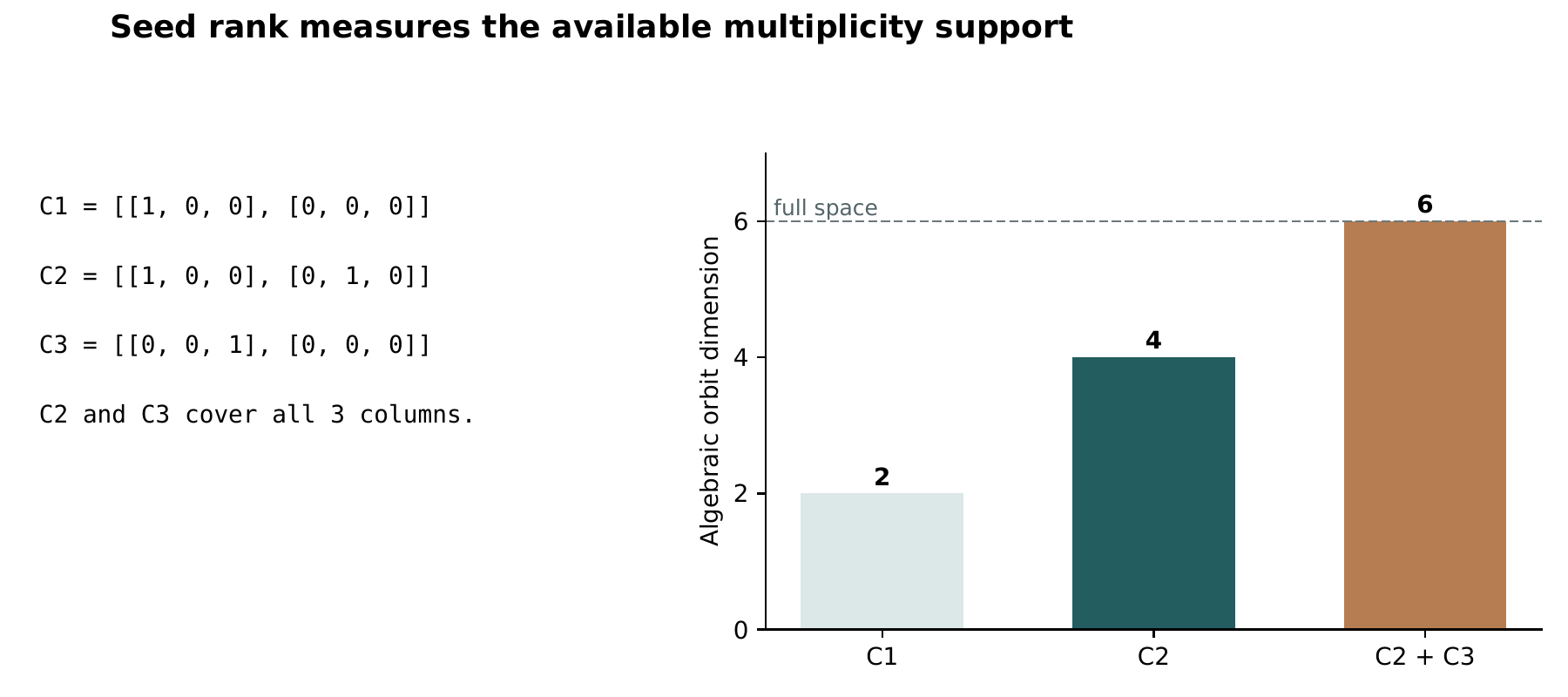
For \(M_2(\mathbb C)\otimes I_3\), a coefficient matrix with rank one generates an orbit of dimension two. A matrix of rank two generates an orbit of dimension four. Neither single seed spans the full space of dimension six, because a \(2\times3\) matrix cannot have rank three. Two seeds can nevertheless cover all three multiplicity coordinates together. The example illustrates the finite seed rank formula with \(d=2\) and \(m=3\).
Text description
The left panel lists coefficient matrices C1, C2, and C3. The bar chart gives orbit dimension two for C1, four for C2, and six for C2 together with C3, reaching the dashed full-space level. These heights are algebraic dimensions, not probabilities.
An eliminated coordinate still contributes
On this page · Permalink · Source line 9
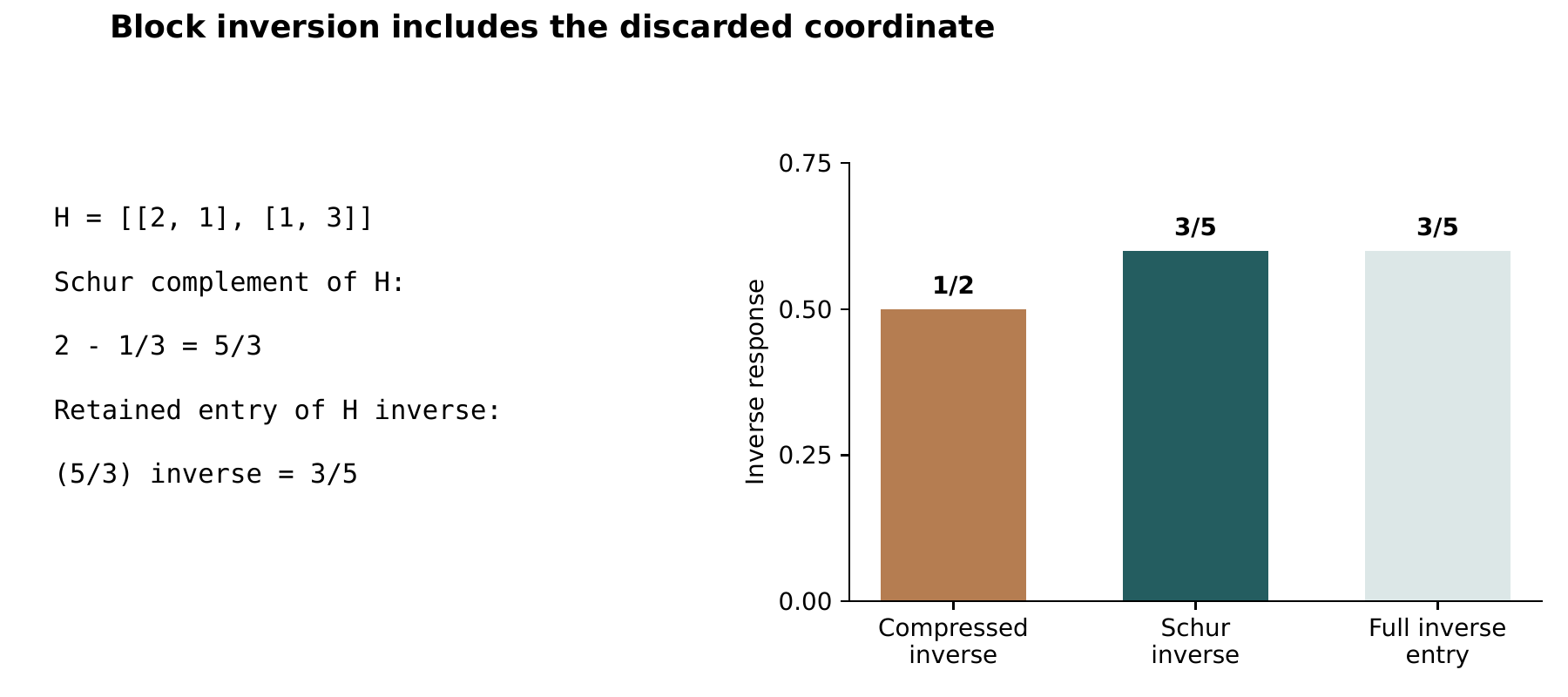
Take \(H=\left(\begin{smallmatrix}2&1\\1&3\end{smallmatrix}\right)\) and retain its first coordinate. The eliminated block is invertible and the Schur complement of \(H\) is \(2-1/3=5/3\). Its inverse is \(3/5\), exactly the retained entry of \(H^{-1}\). Inverting the compressed entry alone gives \(1/2\). The difference records the contribution of a path through the eliminated coordinate. Direct compression omits that contribution, while block inversion retains it.
Text description
The displayed matrix has rows (2, 1) and (1, 3). Inverting the compressed entry gives one half. The Schur complement is five thirds, whose inverse is three fifths, equal to the retained entry of the full inverse. The three bars compare these exact fractions.
Normalization changes the map
On this page · Permalink · Source line 16
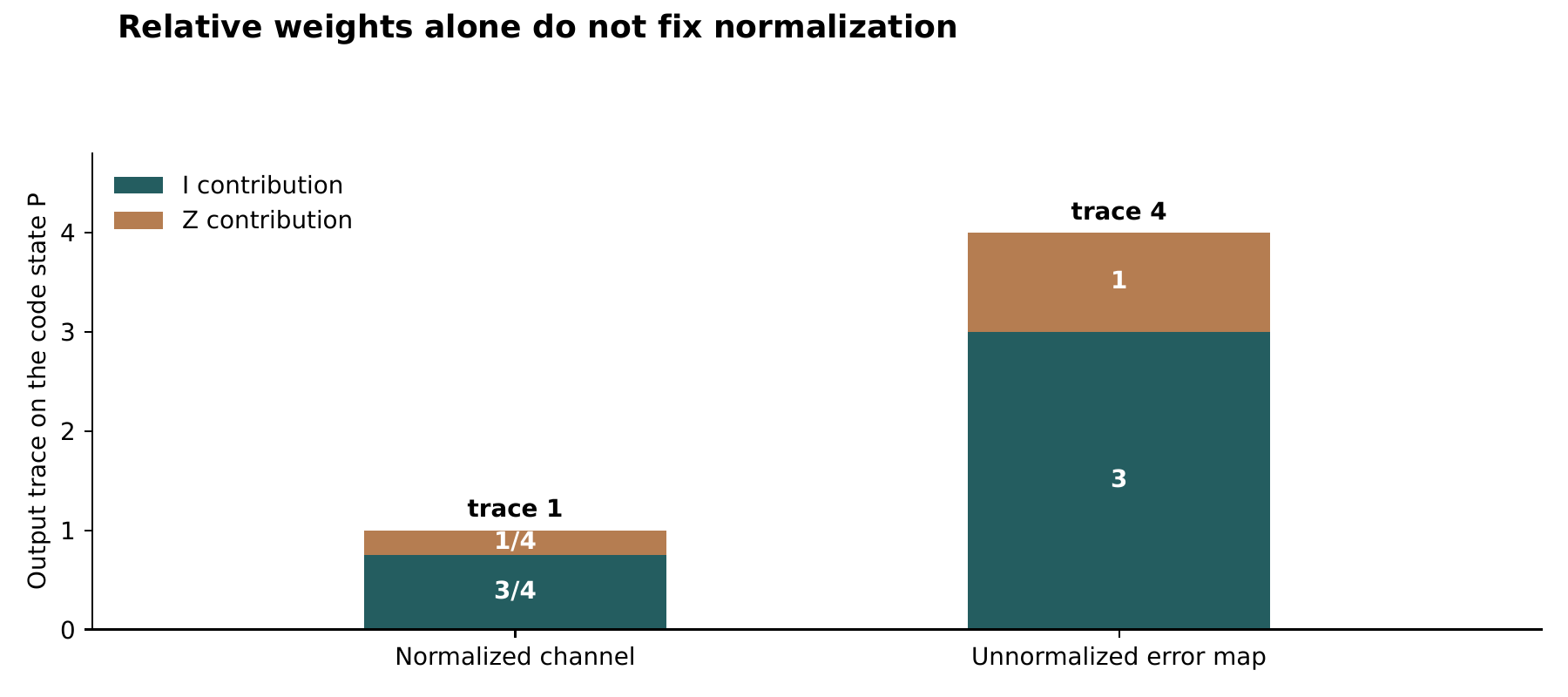
Let \(P=|0\rangle\langle0|\) on \(\mathbb C^2\) and \(Z=\operatorname{diag}(1,-1)\). The normalized Kraus family \(\sqrt{3/4}\,I\), \(\sqrt{1/4}\,Z\) satisfies \(\sum_j K_j^*K_j=I\) and maps \(P\) to \(P\). The unnormalized family \(\sqrt3\,I\), \(Z\) satisfies \(\sum_j E_j^*E_j=4I\) and maps \(P\) to \(4P\). The two families have the same relative weights, but their total normalization differs. Both outputs are proportional to the same projector, but their traces differ.
Text description
Two stacked bars separate identity and Z contributions. The normalized channel has weights three quarters and one quarter, totaling one. The unnormalized positive map has contributions three and one, totaling four. Equal relative weights do not fix total normalization.