Paper VIIReading edition

The quantum seed realization

Reading tools
Reading libraryFind statementsInspect Lean
Switch work

Saved reading

Read side by side

Start reading

Resources & source

Original TeX with line links · Download TeX

The wording and mathematics follow the retained manuscript. This reading format does not add a proof review or extend Lean coverage.

Skip contents and start reading

I.1 The quantum seed realization

Conventions.

Unless the zero space is explicitly included as a boundary case, quantum state spaces are nonzero complex Hilbert spaces of finite dimension. A complete packet family is a finite collection satisfying

\[ P_\alpha^*=P_\alpha,\qquad P_\alpha P_\beta=\delta_{\alpha\beta}P_\alpha,\qquad \sum_\alpha P_\alpha=I. \]

All operator norms in the analytic estimates are induced by the norm on the Hilbert space. The estimates do not use the entrywise maximum norm or the Frobenius norm. We write \([A,B]=AB-BA\) and use units with \(\hbar=1\). Parameter derivatives are real derivatives. A matrix \(X\) is supported on a code projector \(P\) when \(PXP=X\).

The common operator sequence of the series becomes
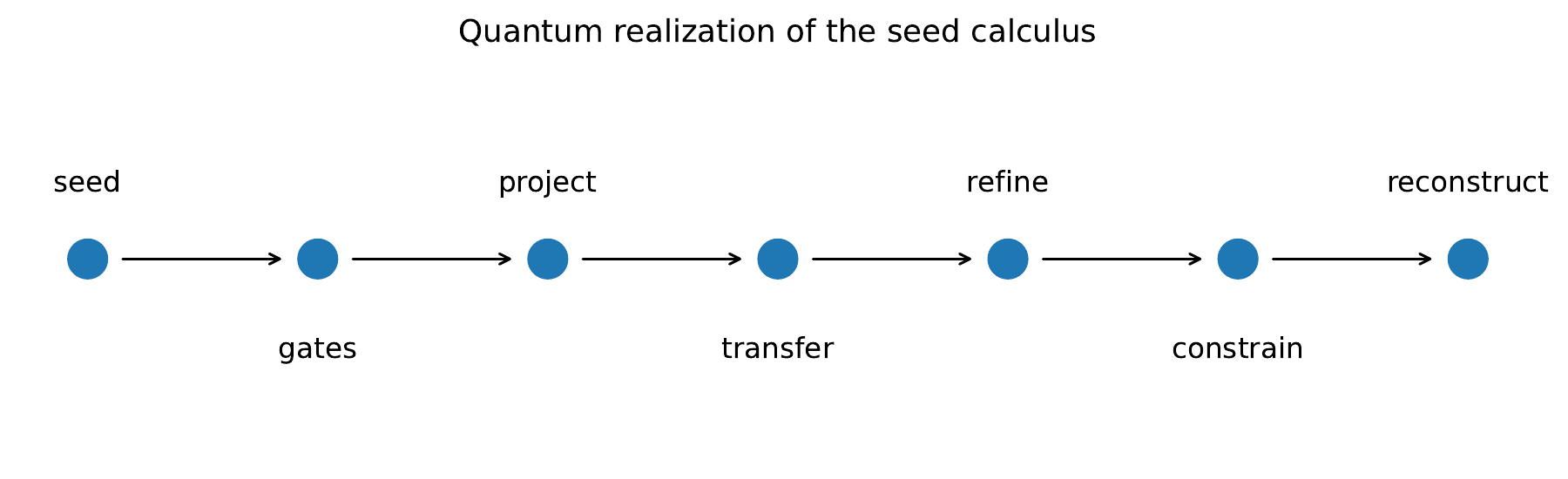
\[ \boxed{ \begin{gathered} \text{quantum seed} \longrightarrow \text{gate or observable address} \longrightarrow \text{symmetry projection}\\ \longrightarrow \text{packet transfer} \longrightarrow \text{constraint} \longrightarrow \text{refinement} \longrightarrow \text{reconstruction} \end{gathered} } \]
The quantum seed calculus shown as a sequence of seven operator stages.
The diagram shows the quantum realization of the common sequence of operators in the seed calculus. The same finite packet language describes states, gates, Hamiltonians, channels, geometric projectors, and effective dynamics.
Text description

Seven nodes are connected from left to right: seed, gates, project, transfer, refine, constrain, and reconstruct. The diagram organizes the finite operator language used across the chapter; it is not an experimental process diagram.

Open original figure (PDF)

View full-size figure (new tab)

Definition I.1.1: Finite quantum seed system

A finite quantum seed system is a tuple

\[ \mathfrak Q= \left( {\mathcal H}, \psi_0, {\mathcal O}, {\mathcal R}, \{P_{\ell,\alpha}\}, H, \tau \right), \]

where \({\mathcal H}\) is a finite-dimensional Hilbert space, \(\psi_0\in{\mathcal H}\) is a nonzero seed, \({\mathcal O}\) is the declared operator grammar, \({\mathcal R}\) is a collection of algebraic or physical constraints, \(\{P_{\ell,\alpha}\}\) is an exact packet system at each refinement level, \(H=H^*\) is a Hamiltonian when dynamics are present, and \(\tau\) specifies the topology used in a later completion.

The generated state space is

\[ {\mathcal H}(\psi_0;{\mathcal O}) = \operatorname{span} \left\{ O_r\cdots O_1\psi_0: O_j\in{\mathcal O}, \ r\ge0 \right\}. \]

The quantum seed is cyclic for the grammar when

\[ {\mathcal H}(\psi_0;{\mathcal O})={\mathcal H}. \]

This is a statement about the pair \((\psi_0,{\mathcal O})\), not about the vector alone. A state may be cyclic for the full matrix algebra and noncyclic for a restricted physical gate set.

Source and conversion record

Source SHA-256: f4fb9d650bb8f6a7a9b6ccdd04882b4c165566f81c962f4765983b0ce77714b9

Unsupported prose commands stop the build. The mathematical expression sequence is checked against the source, with manuscript macros expanded for display.

Conversion records

Notation in Paper VII

Look up a symbol without leaving this chapter. Select text before opening help to search for it.

Search this work’s notation.

    Symbols can have different meanings in different passages. Read each result in its own context.

    Open the full notation index