
I.5 Symmetry-resolved Hamiltonians and leakage
On this page · Permalink · Source line 365
Let \(H=H^*\) and let \(P\) be a packet projector. If \([H,P]=0\), then \(P{\mathcal H}\) is invariant under \(e^{-itH}\).
Theorem I.5.1: Exact symmetry packets
If \([H,P_\alpha]=0\) for every packet, then
and
No amplitude transfers between distinct packets.
Read proof · Read statement and proof side by side · Permalink · Source line 369 · Claim record · Lean coverage · Code · Worked examples
Proof of Theorem I.5.1
The commutation relation gives \(P_\beta HP_\alpha=0\) for \(\beta\ne\alpha\). Every polynomial in \(H\) has the same block form, and the finite-dimensional exponential is the norm limit of its polynomial series.
Back to statement · Read statement and proof side by side · Permalink · Source line 383 · Claim record · Lean coverage · Code · Worked examples
For two qubits and real parameters \(J,h\), consider
In the ordered even basis \(\{{\left|00\right\rangle},{\left|11\right\rangle}\}\) and odd basis \(\{{\left|01\right\rangle},{\left|10\right\rangle}\}\),
Therefore
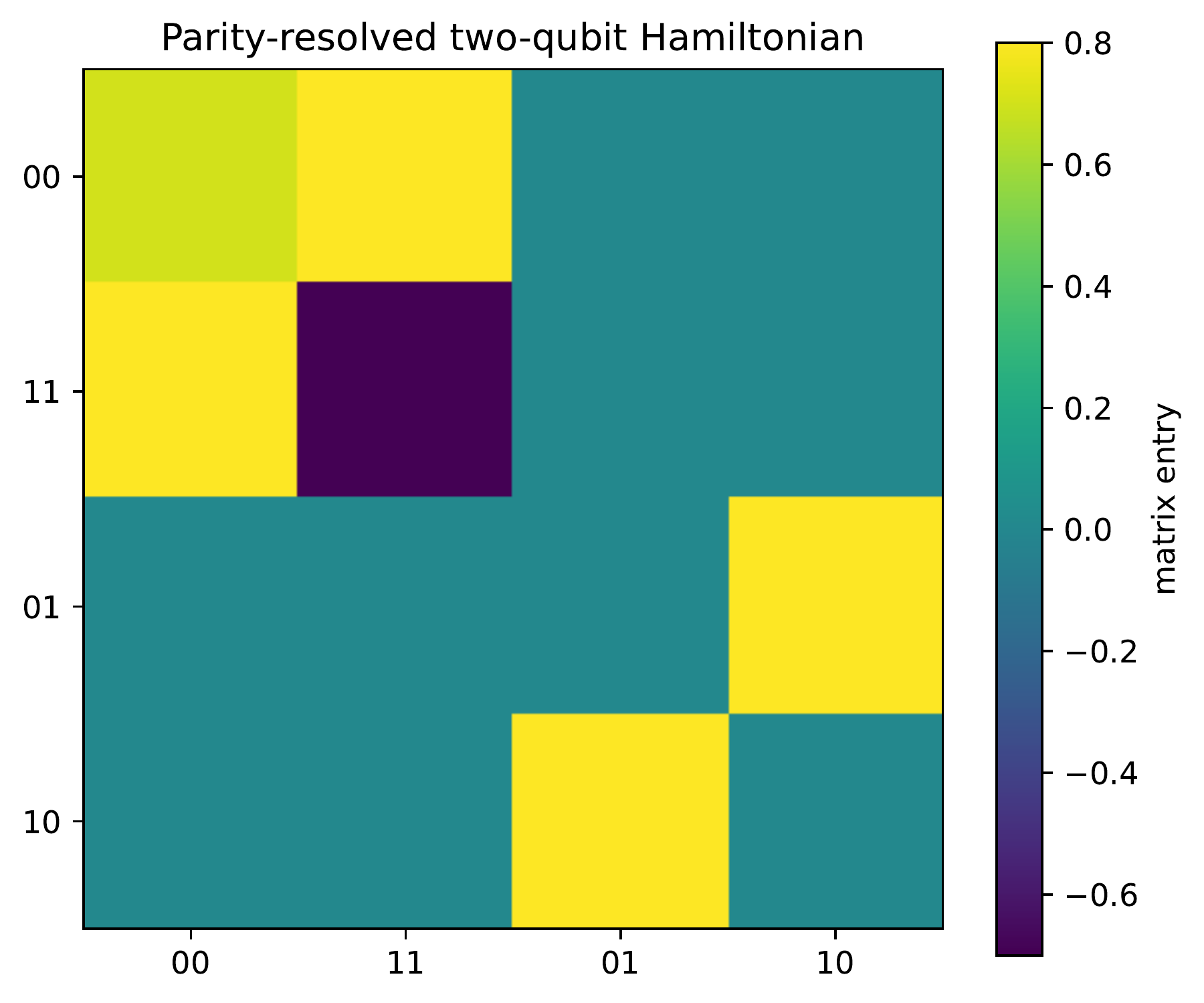
Text description
The basis is ordered 00, 11, 01, 10, so the even addresses come first. Nonzero matrix entries lie in the two diagonal parity blocks. Both off-diagonal blocks are zero, displaying parity-preserving transfer.
I.5.1 Leakage under broken symmetry
On this page · Permalink · Source line 425
Set \(Q=I-P\).
Theorem I.5.2: Commutator leakage bound
For every self-adjoint \(H\), orthogonal projector \(P\), and real time \(t\),
In particular, exact commutation gives zero leakage for all time.
Read proof · Read statement and proof side by side · Permalink · Source line 429 · Claim record · Lean coverage · Code · Worked examples
Proof of Theorem I.5.2
Set \(F(s)=e^{isH}Pe^{-isH}\). Differentiating the exponential gives
Unitary conjugation preserves the operator norm, so \(\|F'(s)\|=\|[H,P]\|\). The mean-value estimate on the interval between \(0\) and \(t\) yields
Finally, \(e^{itH}Qe^{-itH}P=(P-F(t))P\) and \(\|P\|\le1\). Left multiplication by \(e^{itH}\) preserves the norm and gives the desired inequality. This argument includes positive, negative, and zero time.
Back to statement · Read statement and proof side by side · Permalink · Source line 441 · Claim record · Lean coverage · Code · Worked examples
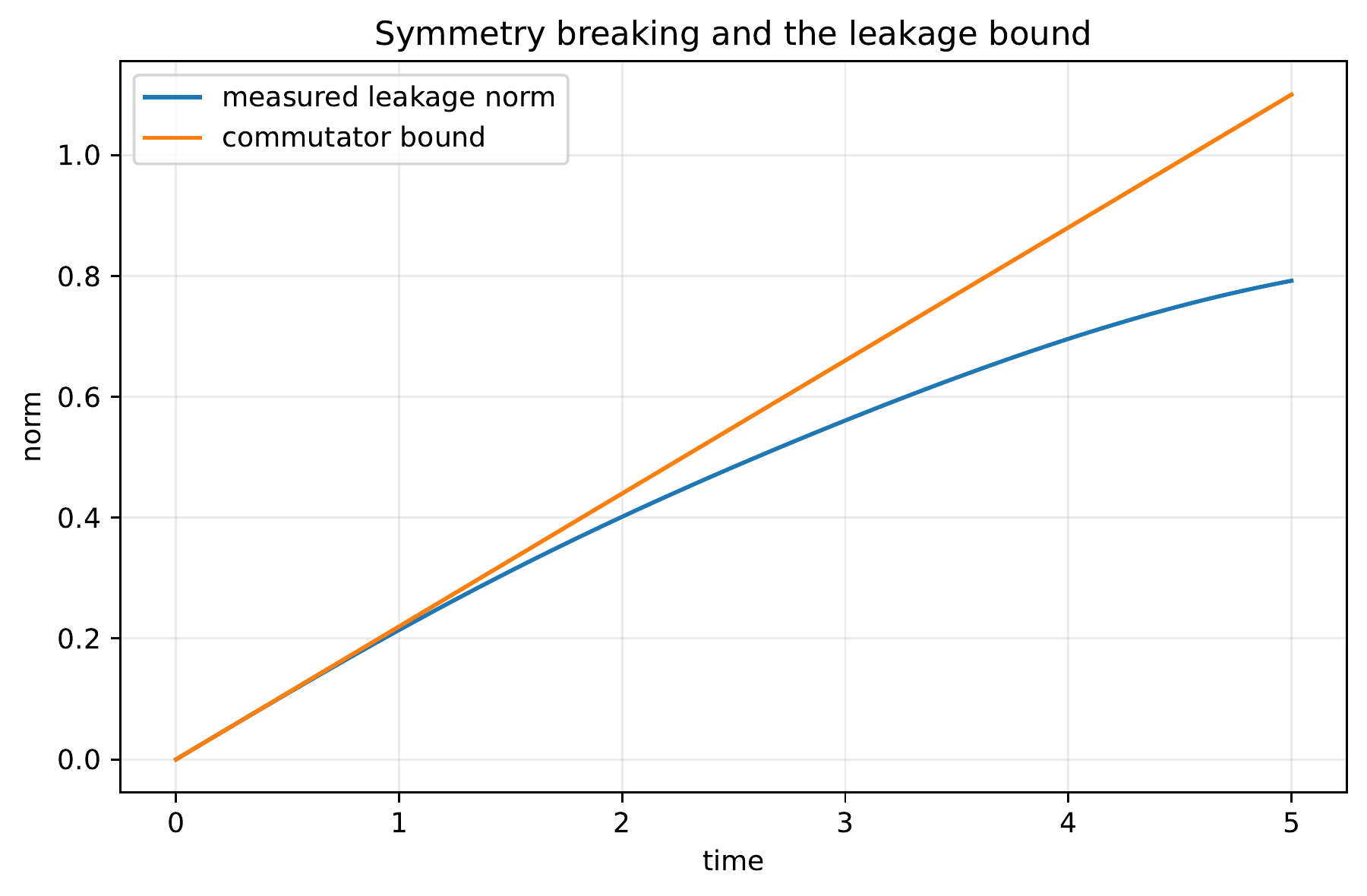
Text description
The horizontal axis is time and the vertical axis is norm. The measured leakage curve rises below the straight commutator-bound curve throughout the plotted interval. This figure illustrates the retained finite perturbation experiment.
Numerical certificate I.5.3: Symmetry and negative control
For the Hamiltonian that preserves parity, the norm of the block between distinct packets and the maximum measured leakage were both \(0\). Adding an \(X\otimes I\) perturbation broke parity and produced a maximum leakage of approximately \(0.79196\). The maximum violation of the proved bound remained \(0\).
Permalink · Source line 460 · Claim record · Lean coverage · Code · Worked examples