
I.7.2 Kraus transfer
On this page · Permalink · Source line 718
A quantum channel can transfer both populations and coherences between packet addresses. A Kraus representation describes this transfer by summing the contributions of its individual branches. The normalization of those branches ensures that the total trace is preserved.
Classical input I.7.2: Finite Kraus channel
Let \(K_1,\ldots,K_r\) satisfy
Then
is completely positive and trace preserving.
Read proof · Read statement and proof side by side · Permalink · Source line 722 · Claim record · Lean coverage · Code · Worked examples
Proof of Classical input I.7.2
Trace preservation follows from
For any auxiliary dimension and positive matrix \(X\), each term
is positive, so their sum is positive. This is complete positivity.
Back to statement · Read statement and proof side by side · Permalink · Source line 736 · Claim record · Lean coverage · Code · Worked examples
Packet superoperator blocks are defined by
Summing all four packet indices reconstructs \(\Phi(X)\) exactly.
For amplitude damping with a real parameter \(0\le\gamma\le1\),
The excited state becomes
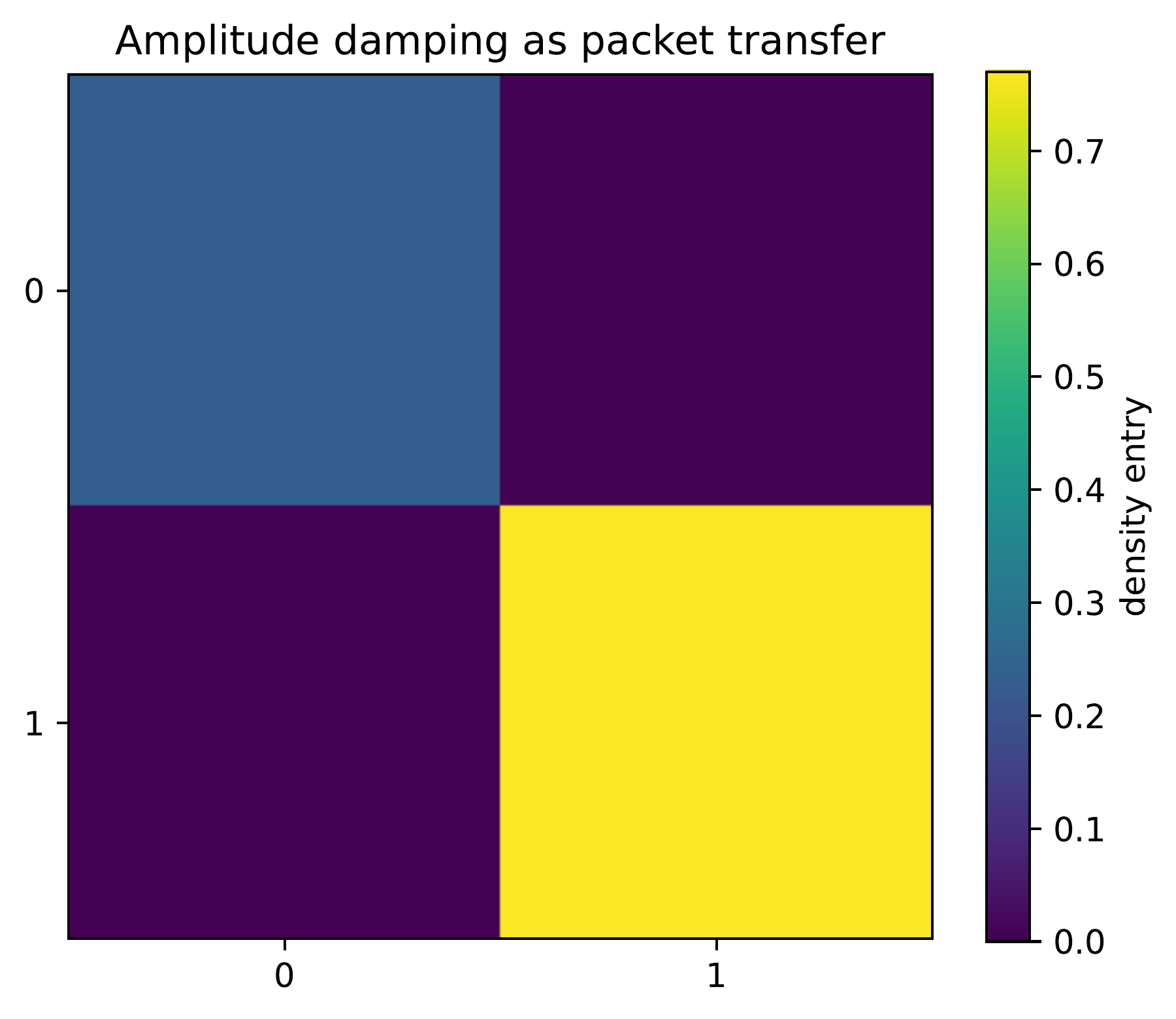
Text description
A two-by-two density-matrix heatmap shows positive entries on the diagonal and zero off-diagonal entries for the displayed excited-state input. The ground population receives the damping contribution while the excited population retains the remainder.
Numerical certificate I.7.3: Channel reconstruction
For \(\gamma=0.23\), the residuals for Kraus completeness and the output trace were \(0\). The computed output from \({\left|1\right\rangle}{\left\langle1\right|}\) was \({\operatorname{diag}}(0.23,0.77)\). In the Bell state test, packet dephasing left every measurement probability in the computational basis unchanged.
Permalink · Source line 786 · Claim record · Lean coverage · Code · Worked examples