
I.8 Quantum error correction as obstruction-packet annihilation
On this page · Permalink · Source line 790
Let \(P=P^*=P^2\) project onto a code space \({\mathcal C}\subset{\mathcal H}\), and let \(E_1,\ldots,E_r\) be a finite family of complex error matrices. Neither a nonzero code nor channel normalization is assumed unless stated. The operators
are the obstruction packets on the code. If they retain information about the logical state beyond one scalar multiple of \(P\), the environment can distinguish logical states and exact correction is impossible.
We call a recovery complete when it is a Kraus map
The family is exactly correctable when one such recovery works for every coherent error combination \(A_w=\sum_aw_aE_a\): for every \(w\) there is a real \(t_w\ge0\), independent of the logical input, such that
The coefficient is an unnormalized weight. It is not necessarily a probability for an arbitrary matrix \(A_w\).
Classical input I.8.1: Finite Knill–Laflamme criterion
The finite error family is exactly correctable in the sense just defined if and only if there is a positive semidefinite complex matrix \(C=(c_{ab})\) such that
If \(\sum_aE_a^*E_a=I\), the equivalent normalized-channel formulation is the existence of a complete recovery satisfying
The zero code and an empty error family are included. An empty family cannot define a channel that preserves trace on a nonzero ambient space.
Read proof · Read statement and proof side by side · Permalink · Source line 809 · Claim record · Lean coverage · Code · Worked examples
Proof of Classical input I.8.1
Necessity. Fix an error \(E_a\) and let \(L_j=K_jE_aP\). Perfect recovery on rank-one code operators gives
For every vector orthogonal to \(\psi\), the quadratic form on the left is a sum of nonnegative squared absolute values and equals zero. Each \(L_j\psi\) therefore lies in the span of \(\psi\). A linear operator that preserves every line in \({\mathcal C}\) is scalar there: apply it to two independent vectors and their sum. The one-dimensional case is immediate, and the claim is vacuous for the zero code. Consequently
Recovery completeness now gives
The coefficients form a Gram matrix, hence are positive semidefinite. For a normalized channel, apply the same rank-one argument to all composite branches \(K_jE_aP\) at once to obtain the necessary condition.
Sufficiency. Diagonalize \(C=U\operatorname{diag}(\lambda_r)U^*\) with \(U\) unitary and \(\lambda_r\ge0\). Define compressed transformed errors
Then \(F_rP=F_r\) and \(F_r^*F_s=\lambda_r\delta_{rs}P\). If \(\lambda_r=0\), \(F_r^*F_r=0\) forces \(F_r=0\). For positive eigenvalues only, set \(V_r=F_r/\sqrt{\lambda_r}\). These satisfy
Let \(S=\sum_{\lambda_r>0}V_rV_r^*\). Orthogonality makes \(S\) an orthogonal projector. Use the recovery branches
They are complete on the whole ambient space because
The inverse unitary change of coordinates reconstructs each \(E_aP\) from the \(F_r\). Every recovery branch of a coherent combination is therefore scalar on the code, while the branch for the unused space vanishes. For all supported matrices, the resulting recovery is
This establishes the arbitrary-family statement without assuming normalization. Under \(\sum_aE_a^*E_a=I\) and \(P\ne0\), summing the diagonal KL equations gives \({\operatorname{Tr}} C=1\), so the normalized-channel output is \(X\). When \(P=0\), every supported \(X\) is zero and the conclusion is automatic. The recovery is trace preserving by completeness and completely positive at every finite ancillary dimension by the Kraus calculation in Classical Input Classical input I.7.2.
Back to statement · Read statement and proof side by side · Permalink · Source line 822 · Claim record · Lean coverage · Code · Worked examples
For the three-qubit bit-flip code,
and the error family is
The four error images of the code are pairwise orthogonal two-dimensional syndrome packets whose projectors sum to the identity on the eight-dimensional Hilbert space.
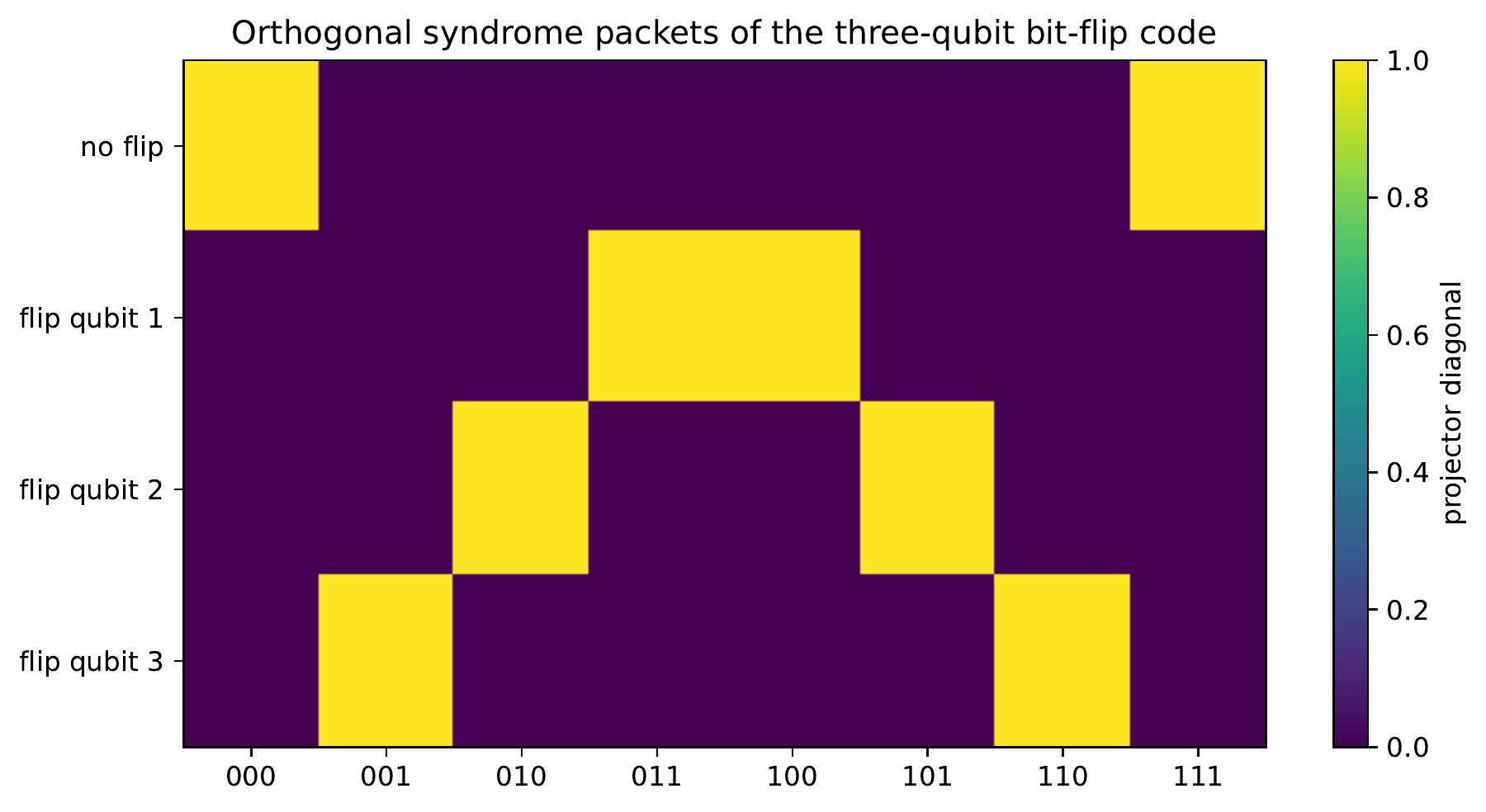
Text description
Rows represent no flip and a flip of each of the three qubits. Columns list the eight computational addresses. Each row has two selected cells: 000 and 111; 100 and 011; 010 and 101; or 001 and 110. The row identifies an error without distinguishing the logical basis states inside it.
Numerical certificate I.8.2: Exact bit-flip correction
The residuals for the Knill–Laflamme condition and completeness of the syndrome packets were both \(0\). A mixed channel of single bit flip errors, applied to a nontrivial logical superposition, was reversed with a residual of \(1.0385\times10^{-16}\) in the density matrix.
Permalink · Source line 888 · Claim record · Lean coverage · Code · Worked examples