
I.10 Finite quantum geometry
On this page · Permalink · Source line 998
I.10.1 A projector-resolved geometry
On this page · Permalink · Source line 1000
At resolution \(\ell\), define
In order, the entries specify the observable algebra, Hilbert space, geometric or Dirac-type operator, packet projectors, embedding into the fine space, reconstruction onto the coarse space, physical constraint projector, and transfer operator. The maps have types \(E_\ell:{\mathcal H}_\ell\to{\mathcal H}_{\ell+1}\) and \(C_\ell:{\mathcal H}_{\ell+1}\to{\mathcal H}_\ell\). The left inverse relation \(C_\ell E_\ell=I\) alone does not imply \(C_\ell=E_\ell^*\) or make the embedding isometric.
A coherent refinement should satisfy
and
For an operator \(D\), define the refinement defect
Exact resolution independence is \(\Delta_\ell(D)=0\). When exact equality is too strong, the correct continuum problem is to prove convergence of the resolvents and uniform control of the effective self-energies.
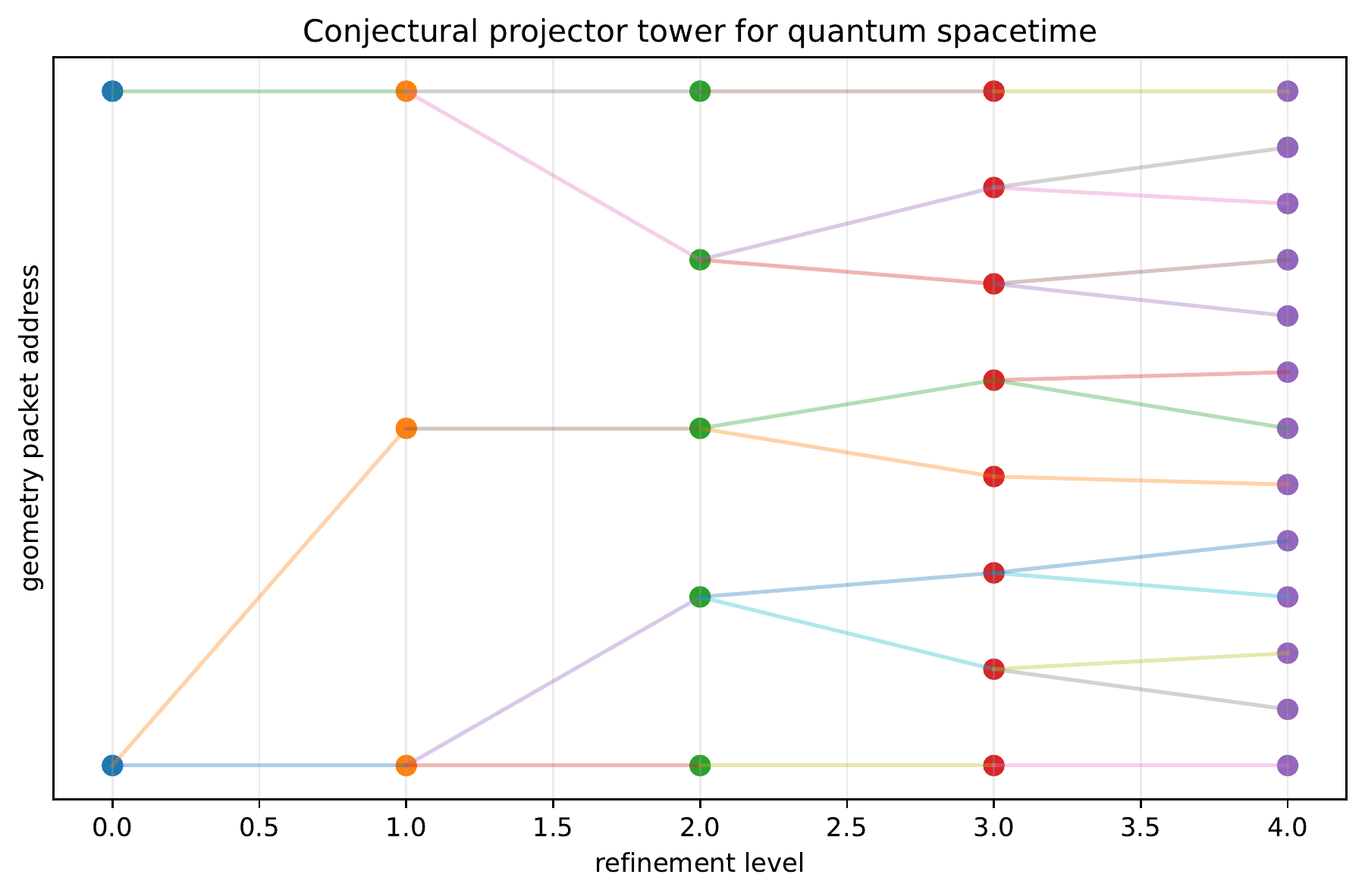
Text description
Colored nodes and connecting branches show sectors subdividing through successive refinement levels. The horizontal axis is refinement level and the vertical axis is conceptual sector. The diagram organizes a proposed tower and does not reconstruct physical spacetime.
I.10.2 Euclidean transfer
On this page · Permalink · Source line 1052
Theorem I.10.1: Finite Euclidean transfer
Let \(H\) be Hermitian on a nonzero finite-dimensional Hilbert space. For all real \(\tau,\sigma\ge0\),
is positive definite and satisfies
Its spectrum is contained in \((0,1]\).
Read proof · Read statement and proof side by side · Permalink · Source line 1054 · Claim record · Lean coverage · Code · Worked examples
Proof of Theorem I.10.1
Diagonalize \(H=\sum_jE_jP_j\). Then
Every eigenvalue is strictly positive and at most one. Multiplication adds the exponents, proving the semigroup law and \(T(0)=I\). Positivity here is operator positivity, not an assertion that every matrix entry is nonnegative.
Back to statement · Read statement and proof side by side · Permalink · Source line 1070 · Claim record · Lean coverage · Code · Worked examples
The paper tests a controlled volume-state model
with \(\kappa>0\) and a real confining potential. This is a finite transfer-matrix test only. Operator positivity alone is not reflection positivity of a Euclidean field measure. It is not derived from a gravitational path integral and is not evidence for a unique microscopic spacetime dynamics.
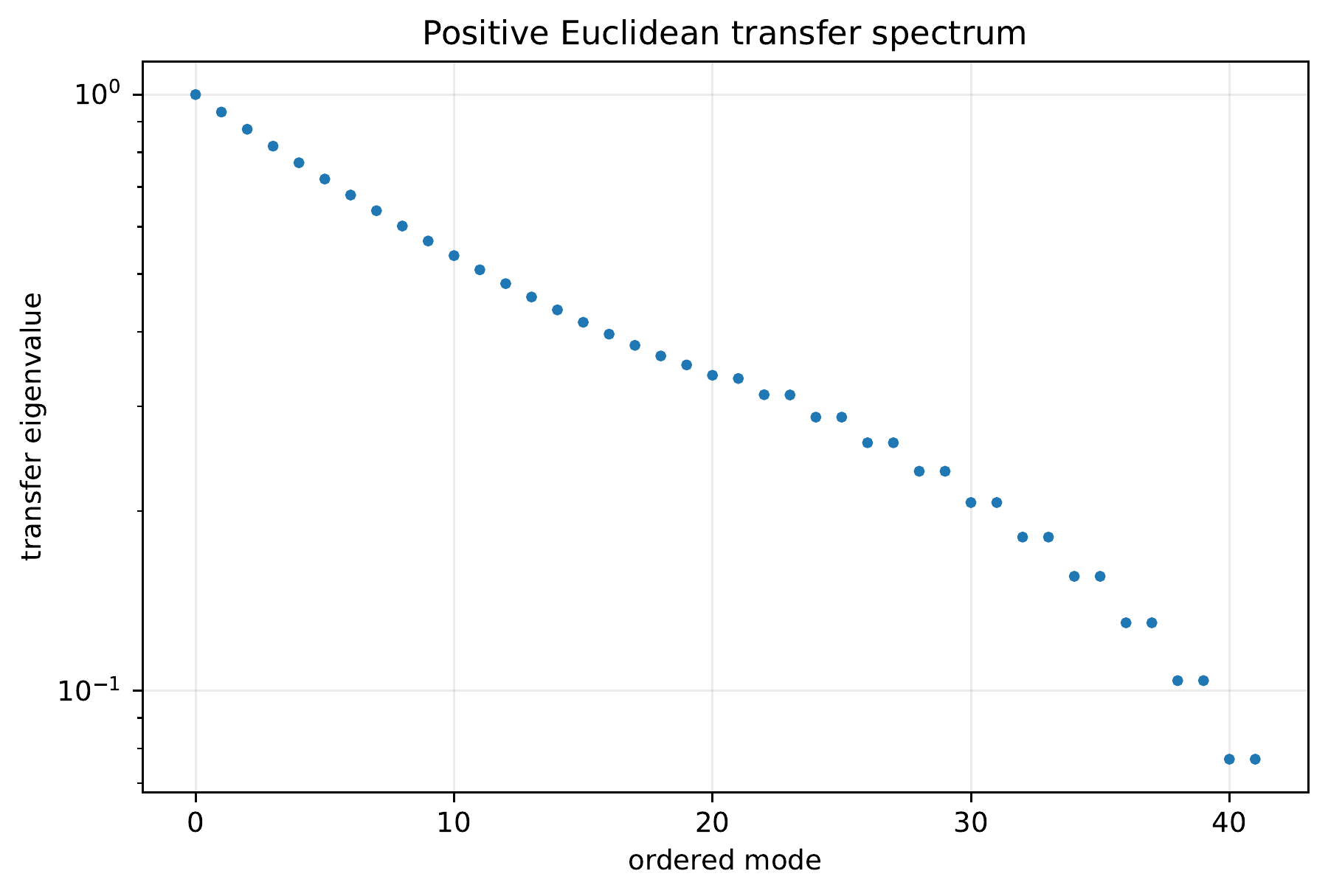
Text description
Transfer eigenvalues are plotted by ordered mode on a logarithmic vertical axis. The points descend while remaining positive. The plot records the finite Euclidean transfer spectrum used in the manuscript.
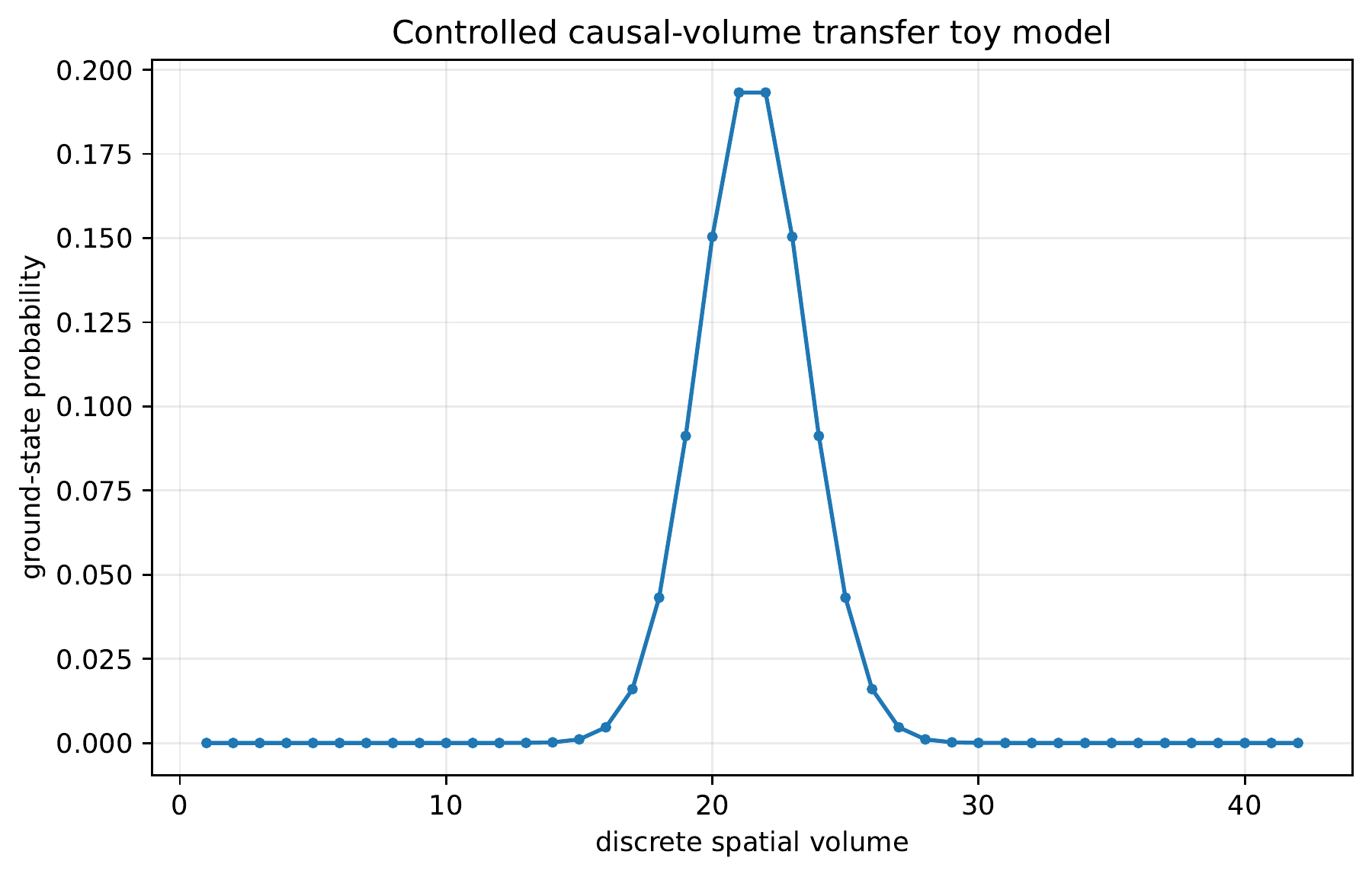
Text description
The horizontal axis is discrete spatial volume and the vertical axis is ground-state probability. A narrow peak appears around the center of the displayed volume range, with small tails toward both ends. Its interpretation is restricted to the controlled toy model.
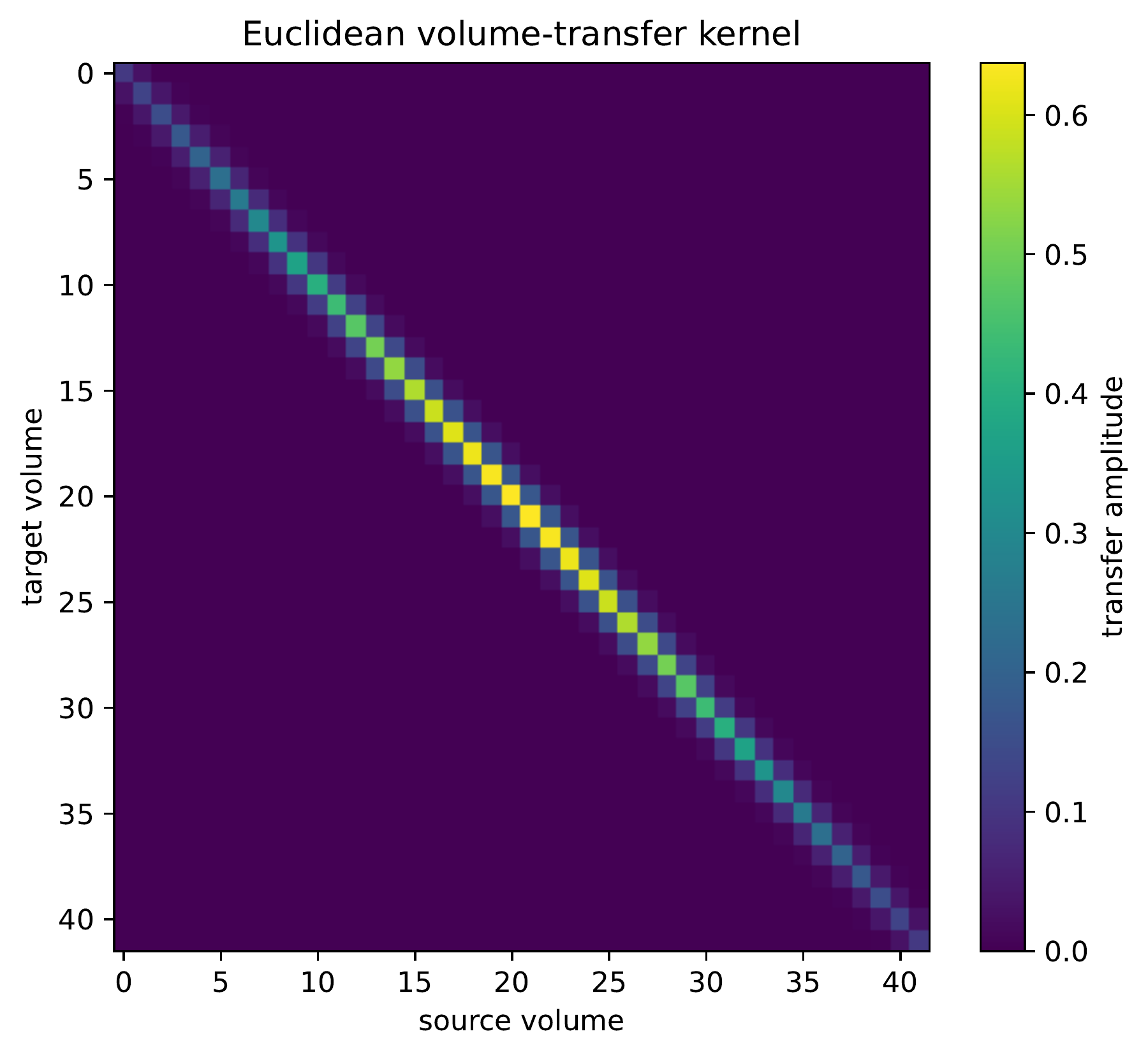
Text description
A heatmap uses source volume on columns and target volume on rows. The largest entries follow a diagonal band and decrease away from it. The color scale denotes transfer amplitude in the finite Euclidean model; a gravitational interpretation remains provisional.
Numerical certificate I.10.2: Finite transfer model
The minimum transfer eigenvalue was \(0.0767054\), the semigroup residual was \(0\), and reconstruction from four volume-residue packets had residual \(0\).
Permalink · Source line 1109 · Claim record · Lean coverage · Code · Worked examples