
I.3 Cyclic symmetry packets
On this page · Permalink · Source line 184
I.3.1 Character projectors
On this page · Permalink · Source line 186
Let \(N\ge1\) be an integer, and let \(S\) be a unitary symmetry whose order divides \(N\):
Set \(\omega=e^{2\pi i/N}\).
Theorem I.3.1: Cyclic quantum projectors
The operators
are self-adjoint, pairwise orthogonal projectors satisfying
Read proof · Read statement and proof side by side · Permalink · Source line 194 · Claim record · Lean coverage · Code · Worked examples
Proof of Theorem I.3.1
Using \(S^{r+s}=S^{r+s\bmod N}\) and the finite character orthogonality relation,
we obtain \(P_jP_k=\delta_{jk}P_j\). Summing over \(j\) cancels every term indexed by \(r\ne0\) and retains the \(r=0\) term, which proves completeness. Unitarity and the change of residue \(r\mapsto-r\) give
Finally, multiplication by \(S\) shifts the summation index and contributes the factor \(\omega^j\).
Back to statement · Read statement and proof side by side · Permalink · Source line 215 · Claim record · Lean coverage · Code · Worked examples
For parity,
I.3.2 Tensor refinement
On this page · Permalink · Source line 236
Fix \(N\ge1\). Suppose every factor \(a\) has a complete orthogonal family \(P^{(a)}_0,\ldots,P^{(a)}_{N-1}\). The fine tensor packets are
Theorem I.3.2: Tensor/polyphase refinement
For each residue \(r\in{\mathbb Z}/N{\mathbb Z}\), define
Then the \(P_r^{\mathrm{coarse}}\) are complete orthogonal projectors, and every coarse packet is the exact sum of its fine descendants.
Read proof · Read statement and proof side by side · Permalink · Source line 245 · Claim record · Lean coverage · Code · Worked examples
Proof of Theorem I.3.2
The fine tensor projectors are mutually orthogonal and sum to the identity. Grouping the fine addresses by their total residue partitions the full address set. Sums over disjoint sets of orthogonal projectors remain orthogonal projectors, and the union of the residue classes is the full fine address set.
Back to statement · Read statement and proof side by side · Permalink · Source line 258 · Claim record · Lean coverage · Code · Worked examples
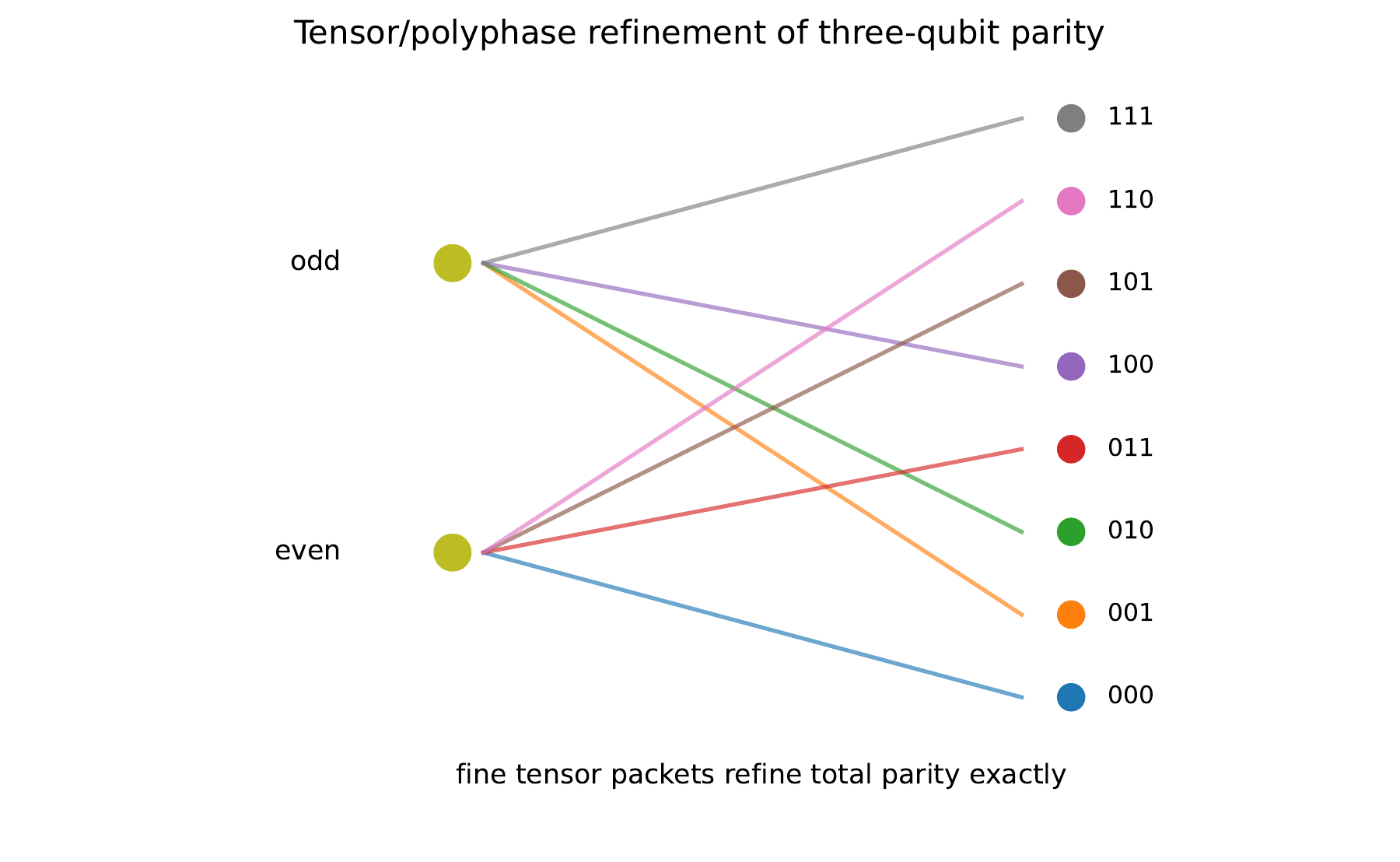
Text description
Two coarse nodes, even and odd parity, connect to the eight three-bit addresses. Each address belongs to the parity determined by its number of one bits. The links show refinement into computational packets while retaining the total parity grouping.
Numerical certificate I.3.3: Exact parity refinement
For three qubits, the local computational projectors were grouped by the parity of their Hamming weight. The resulting coarse projectors agreed with \((I\pm Z^{\otimes3})/2\) with residual \(0\).
Permalink · Source line 269 · Claim record · Lean coverage · Code · Worked examples