
I.12 Constraint packets and the quantum-spacetime boundary
On this page · Permalink · Source line 1196
At one finite level, let \(\widehat C_A\) be a finite family of matrix constraints, with fixed scalar structure coefficients, and let \(\Pi^{\mathrm{phys}}\) be the orthogonal projector onto their exact common kernel. If the classical constraint algebra has structure coefficients \(f_{AB}^{\ \ C}\), define the anomaly operator
Its physical packet is
In this exact finite setting, \(\widehat C_C\Pi^{\mathrm{phys}}=0\) for every \(C\). Associativity gives
automatically. This compression therefore cannot certify operator closure away from the physical range. A nonzero measured compression contradicts the exact-kernel assumptions or indicates an approximation or implementation error. For example, \(C_1=\operatorname{diag}(1,0,0)\) and \(C_2=E_{12}+E_{21}\) annihilate the same third coordinate, while their commutator \(E_{12}-E_{21}\) is nonzero. With zero proposed structure coefficients, the anomaly is nonzero but its physical compression vanishes.
The closure target must be stated at the operator level, not inferred from that automatic compression. Unbounded constraints additionally require a specified common invariant domain. Neither such a domain theory nor gravitational structure functions are supplied by the finite check.
Conjecture I.12.1: Anomaly-free refinement
For a specified nontrivial quantum-geometric constraint model, there exists a coherent packet tower with nonzero physical spaces, compatible physical projectors, and exact operator closure
at every finite level. The compatible physical compression then vanishes as a consequence, not as a substitute for closure.
Permalink · Source line 1221 · Claim record · Lean coverage · Code · Worked examples
The substantive research target is the operator condition. The earlier condition stated only in terms of compression was too weak. A choice of model, dynamics, and refinement maps is still needed before this program becomes a fully specified physical existence problem.
Conjecture I.12.2: Uniform Feshbach control
For the same specified tower, the self-energies from exact elimination of fine packets admit bounds uniform in cutoff and volume on a common spectral domain. Together with consistent identifications of the Hilbert spaces and a proved resolvent convergence criterion, they yield a nontrivial continuum limit in the strong resolvent sense. Uniform boundedness alone is not asserted to imply convergence.
Permalink · Source line 1230 · Claim record · Lean coverage · Code · Worked examples
Conjecture I.12.3: Lorentzian reconstruction
The Euclidean packet theory satisfies a positivity or reconstruction principle strong enough to produce a Lorentzian Hilbert space with causal propagation and positive physical norm.
Permalink · Source line 1234 · Claim record · Lean coverage · Code · Worked examples
Conjecture I.12.4: Einstein infrared limit
There exist semiclassical packet states \(\Psi_{g,\ell}\) such that the effective action converges to
with controlled higher-order corrections.
Permalink · Source line 1238 · Claim record · Lean coverage · Code · Worked examples
Conjecture I.12.5: Massless spin-two sector
The continuum two-point function possesses a positive transverse-traceless massless spin-two pole, while all unphysical packet sectors are removed by the constraints.
Permalink · Source line 1247 · Claim record · Lean coverage · Code · Worked examples
The exact finite identities establish none of these physical conclusions, and no formal theorem of logical independence is claimed. Exact packet reconstruction provides a kinematic and computational advantage. It does not determine the physical action, prove existence of the continuum theory, or guarantee the limit of general relativity.
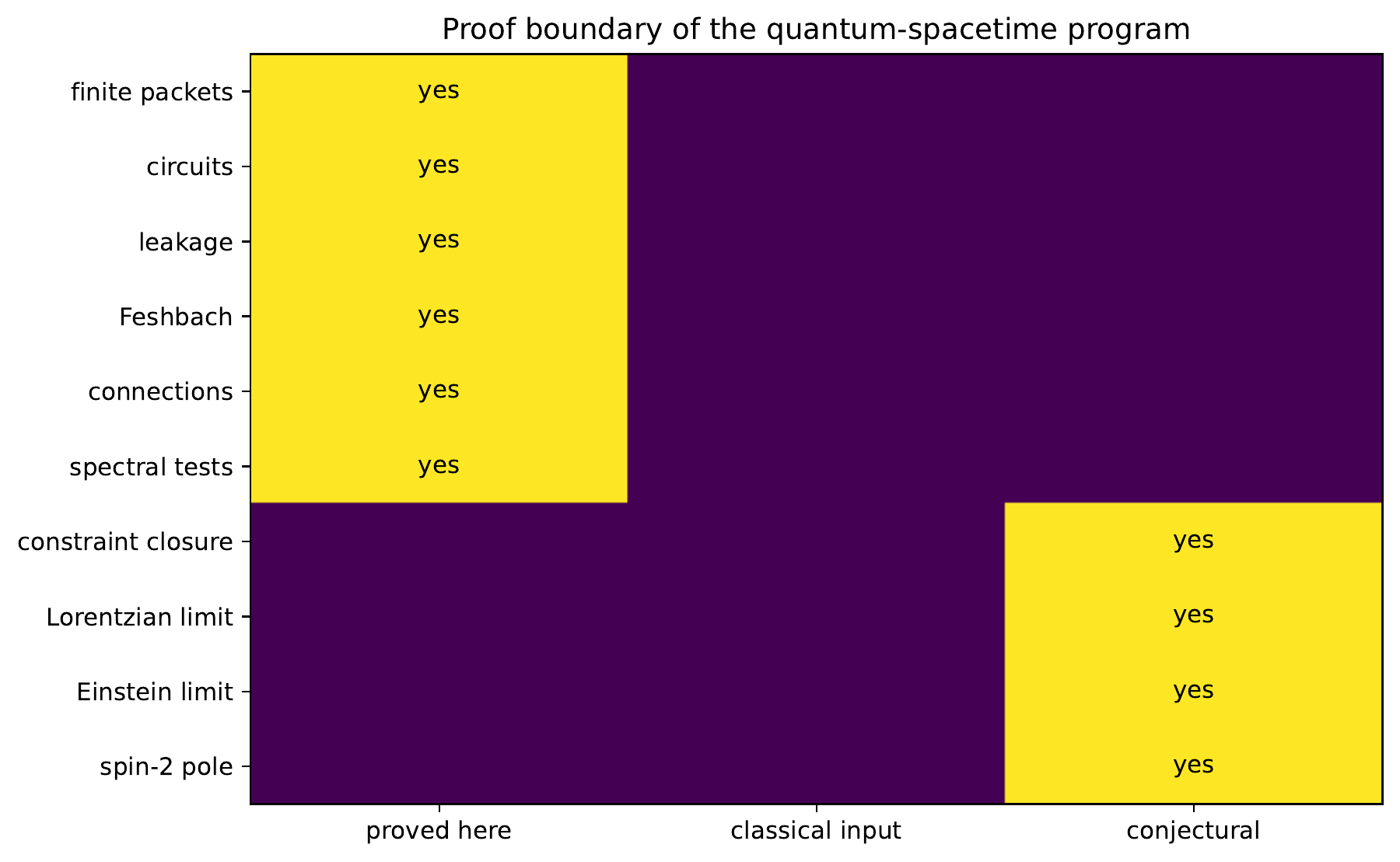
Text description
The rows list finite packets, circuits, leakage, Feshbach reduction, connections, spectral tests, and later physical targets. The first group is marked in the proved-here column. Constraint closure and the Lorentzian, Einstein, and spin-two targets are marked conjectural.