
1 The universal seed at residual depth
On this page · Permalink · Source line 137
The earlier papers treat a seed as a primitive object together with an operator grammar, a packet system, a topology, and an exact reconstruction law. In arithmetic deformation problems, the primitive coordinate has two layers:
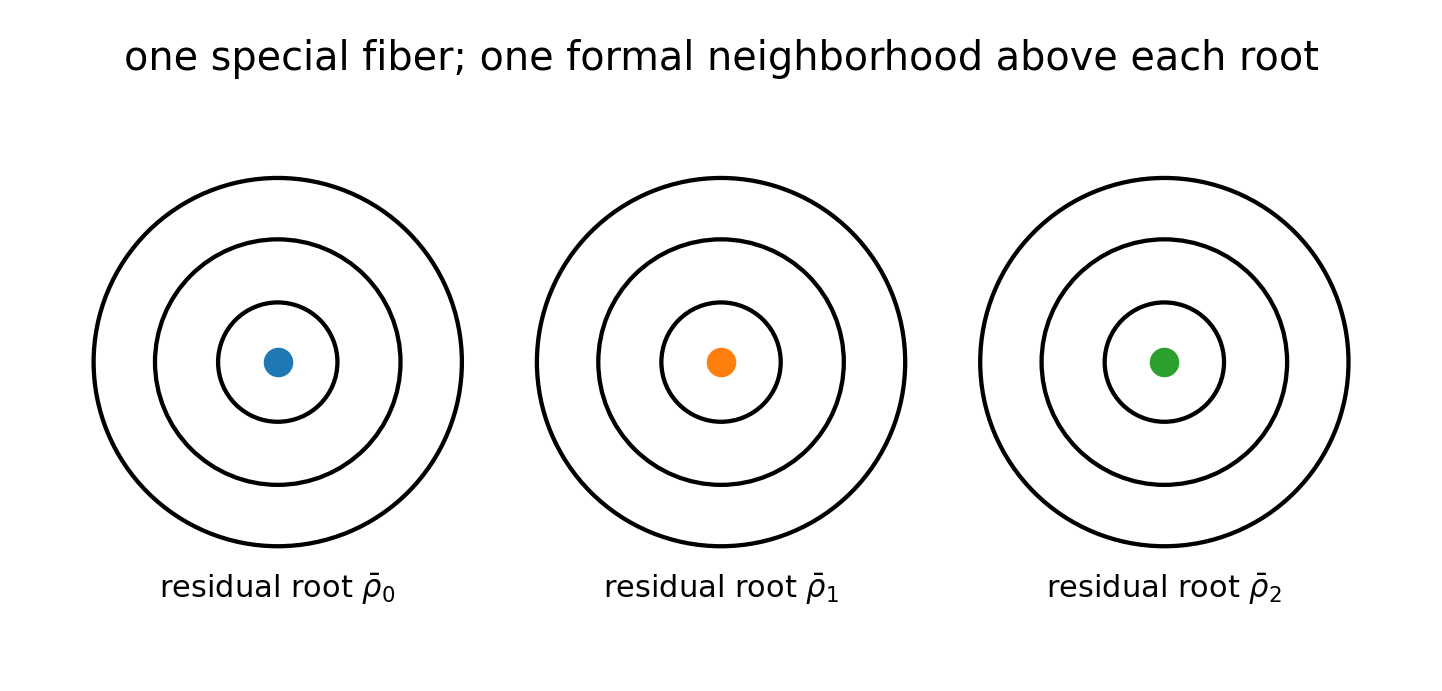
The distinction is structural. A correction divisible by the uniformizer changes higher digits but leaves the residual digit fixed. Therefore the correct universal arithmetic seed cannot be one residual representation unless the admissible residual space has only one point. It must contain every residual root and the complete formal neighborhood above each root.
Let \({\mathcal O}\) be a complete discrete valuation ring with uniformizer \(\varpi\), maximal ideal \((\varpi)\), residue field
and fraction field \(K\). When a characteristic-zero conclusion is intended, assume additionally that \(\operatorname{char}K=0\); the general counting statements do not require that restriction. Let \(\mathcal M\) be a moduli functor on complete local Noetherian \({\mathcal O}\)-algebras with residue field \(k\), equipped with a well-defined reduction map
For a Galois representation this means either that a framed integral model has been fixed or that the residual semisimplified class is used.
Definition 1.1: Residual seed system
For \(\bar x\in\mathcal M(k)\), define the residual fiber
The point \(\bar x\) is the residual root. The family of all nonempty fibers is the residual special fiber, and the formal deformation problems above them form the residual forest.
Visual guide: An atlas of the objects · Permalink · Source line 161 · Claim record · Lean coverage · Code · Worked examples
For a Galois problem the principal example is
with a deformation functor \({\operatorname{Def}}_{\bar\rho}\) cut out by a determinant and selected local conditions.
1.1 What the paper is designed to separate
On this page · Permalink · Source line 183
Three statements are often compressed into one sentence even though they have different logical content.
Vertical completeness: every compatible perturbation stream above a fixed root reconstructs a point of its complete deformation space.
Horizontal companion existence: every required residual root, including roots at other coefficient primes, actually exists.
Occupancy: the resulting arithmetic packet occurs in a nonzero global carrier of the required type.
The first belongs to deformation and inverse-limit theory. The second is a residual companion problem. The third is an arithmetic or automorphic nonvanishing problem. Neither of the last two follows from arbitrarily deep perturbation above one already occupied root.