Paper XReading edition

Worked finite models

Reading tools
Reading libraryFind statementsInspect Lean
Switch work

Saved reading

Read side by side

Start reading

Resources & source

Original TeX with line links · Download TeX

The wording and mathematics follow the retained manuscript. This reading format does not add a proof review or extend Lean coverage.

Skip contents and start reading

12 Worked finite models

12.1 Smooth branch

For \(q=3\) and formal dimension \(d=2\), the finite levels have cardinalities

\[ 1,9,81,729,6561,\ldots. \]

The seed zeta function is

\[ Z(T)=\frac{T}{1-9T}. \]

12.2 Weighted dyadic chart

For weights \((1,2,4)\), the counts are

\[ 1,2,8,32,256,2048,\ldots. \]

The first coordinate is active immediately, the second one level later, and the third at depth five. The exact rational function generated by the code is

\[ Z_{(1,2,4)}(T) = \frac{T(1-6T-8T^2-32T^3)}{1-8T}. \]

The negative signs in this presentation arise from moving the denominator to \(1-8T\); every power-series coefficient is positive.

12.3 Singular branch

For \(x^2=0\) over a residue field of size three, the counts are

\[ 1,3,3,9,9,27,27,81,\ldots, \]

and

\[ Z(T)=\frac{T+3T^2}{1-3T^2}. \]

The exact branching dimension is \(1/2\).

12.4 Directed transport

The finite graph in Figure 10 has three source components. The source-component theorem and brute-force enumeration both return the minimum seed count three.
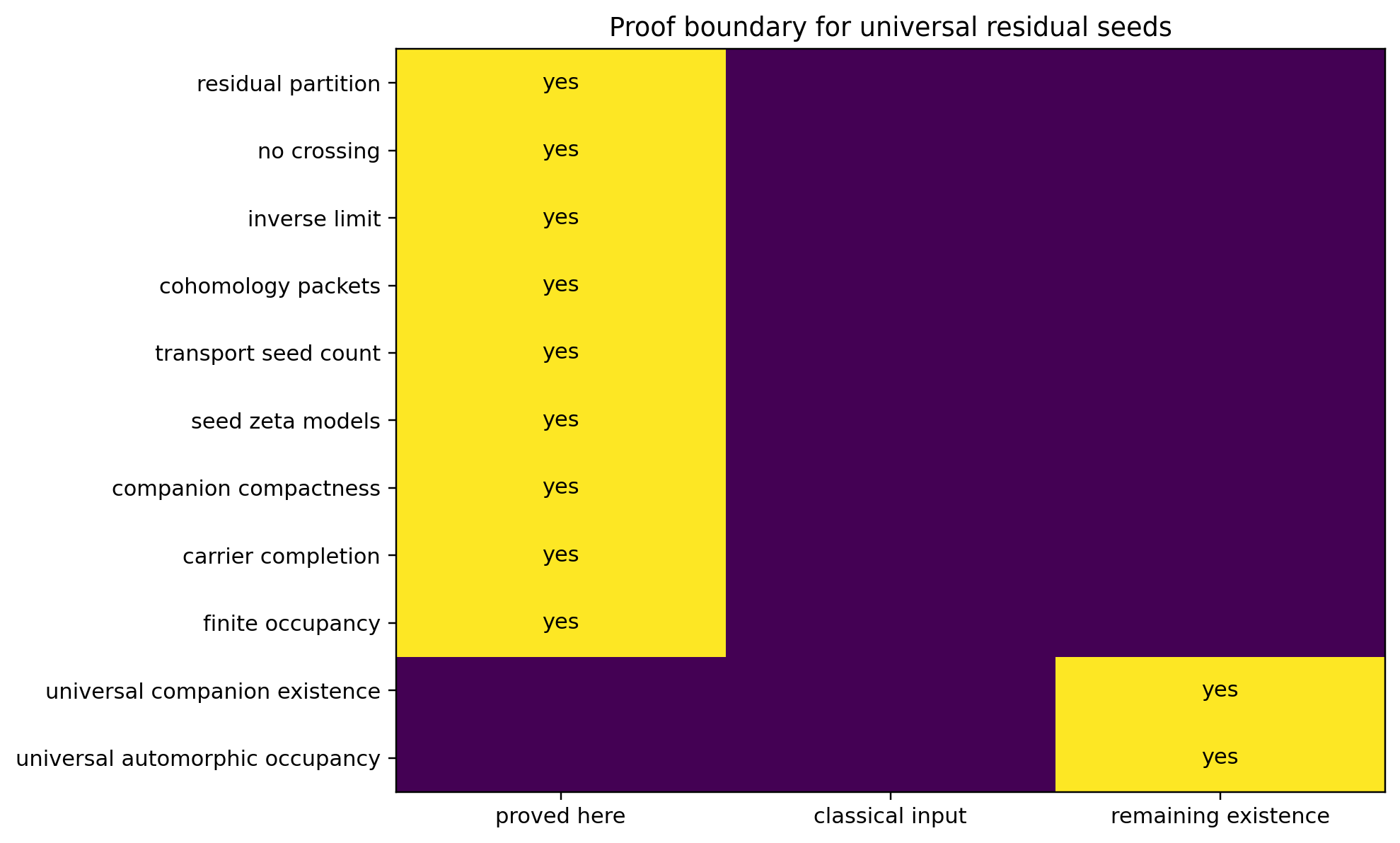
The finite and formal statements proved in this paper are separated from the two remaining universal existence assertions.

View full-size figure (new tab)

Source and conversion record

Source SHA-256: ccce6fc50bc2c300d987aa870a199494867a6c52e119b49d7b17c100a0213652

Unsupported prose commands stop the build. The mathematical expression sequence is checked against the source, with manuscript macros expanded for display.

Conversion records

Notation in Paper X

Look up a symbol without leaving this chapter. Select text before opening help to search for it.

Search this work’s notation.

    Symbols can have different meanings in different passages. Read each result in its own context.

    Open the full notation index