
D.11 Verification and exact boundaries
On this page · Permalink · Source line 3078
The proofs in the article are symbolic. Exact computation tests formulas, finite ranges, and the source implementation. It does not replace a uniform proof.
| Block | Status | Main boundary |
|---|---|---|
| Standard window period | Proved modulo the residue prime | Higher prime powers require inverse estimates |
| Unified local Euler transfer | Proved for every prime | Odd and dyadic integral charts remain different |
| Dyadic kernel and truncation | Exact weight and optimal uniform modulus proved | Row cancellation may give stronger values |
| Carmichael and Mahler transfer | Proved for scalar, polynomial exponential, matrix, and finite adelic systems | A jump congruence must first be available |
| Local Euler interpolation | Proved for depleted odd branches and the direct dyadic branch | The odd nonunit factor is only evaluated at integer interpolation points |
| Affine polyphase transfer | Exact analysis, synthesis, carry law, kernel composition, residual sparsity, and valuation preservation proved | General exact kernel valuations remain open |
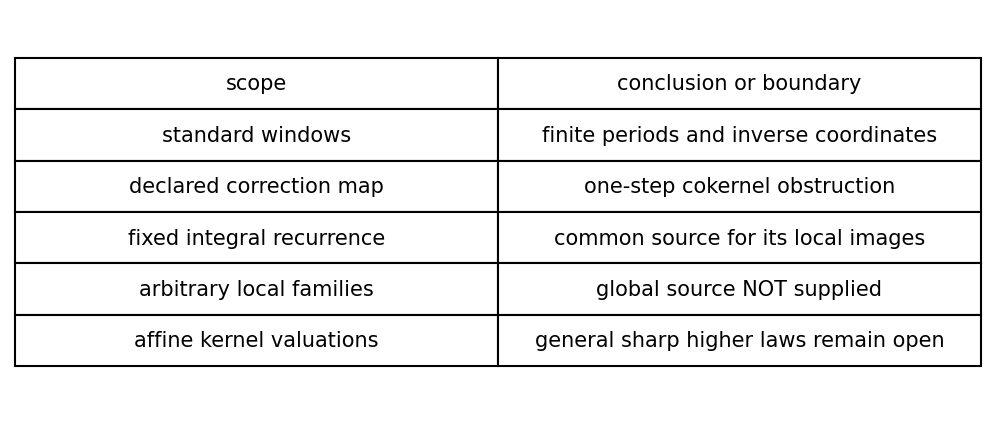
| Lift obstruction and recurrence spine | Proved for the declared local problems and integral recurrences | Unrestricted global gluing is not proved |
D.11.1 The remaining congruential difference problem
On this page · Permalink · Source line 3101
Let \(C_{mp,j}(n)\) be a congruential reciprocal coefficient and let
The unit mode calculations suggest bounds for
The theorems of Subsection D.6 and Subsection D.7 determine the gain before the congruential triangular inverse is applied. They do not yet determine every valuation loss introduced by that inverse. The full family bound therefore remains open.
D.11.2 Higher valuations of the affine kernel
On this page · Permalink · Source line 3113
The residual formula
is exact. A closed formula for
in terms of base \(p\) carries and the three digit addresses is not proved here. Such a formula would sharpen the min plus valuation ledger and could distinguish optimal refinement trees.
D.11.3 The remaining global gluing problem
On this page · Permalink · Source line 3128
The finite adelic theorem synchronizes a finite set of primes when one integral state system is already fixed. The recurrence theorem gives a common local source under the same assumption. Chinese remainder projectors reconstruct finite residue addresses. None of these results proves that an arbitrary collection of local analytic branches has a common global arithmetic origin.
D.11.4 Historical scope
On this page · Permalink · Source line 3139
The article uses classical work on Euler congruences, finite differences, local fields, Hurwitz series, Mahler interpolation, Lucas congruences, and recurrence sequences [CarlitzLevine1960], [Young1999], [Young2001], [Sun2008], [Chen2004], [Lucas1878a], [LidlNiederreiter1997], [EverestVanDerPoortenShparlinskiWard2003]. The exact formulas and local transfer statements should be compared individually with that literature before any historical priority claim is made.