
D.4 Congruential reciprocal packets
On this page · Permalink · Source line 571
D.4.1 Residue sections of the exponential series
On this page · Permalink · Source line 573
For integers \(N\geq1\) and \(0\leq j<N\), define
The forced factor \(t^j\) may be removed without changing the residue address.
Historical definition D.20: Congruential reciprocal packet
Define
Historical theorem D.21: Triangular inverse system
The coefficients satisfy \(C_{N,j}(0)=1\) and
For \(n\geq1\),
Proof
Multiply \({\mathcal C}_{N,j}(t)\) by \({\mathcal E}_{N,j}(t)\) and compare the coefficient of \(t^{Nn+j}/(Nn+j)!\). The last summand is the diagonal term, which is nonzero over \({\mathbb Q}\).
Historical proposition D.22: A denominator bound
Let
Then
For every prime \(p\),
Proof
Use induction on \(n\) in the recurrence of Historical theorem D.21. Every earlier denominator divides \(D_{N,j}(n-1)\), while the new diagonal denominator is the final factor of \(D_{N,j}(n)\). The valuation statement follows.
Historical example D.23: Euler and Bernoulli boundaries
For \((N,j)=(2,0)\),
so
For \((N,j)=(2,1)\),
and
The usual convention \(B_1=-1/2\) is used. Euler and Bernoulli number conventions are reviewed in [Comtet1974], [Stanley2012].
D.4.2 Standard windows
On this page · Permalink · Source line 684
Fix a prime \(p\), an integer \(m\geq1\), and an address \(0\leq j<p\). Put
For arbitrary \(m\), let \(\widetilde e_n^{(m,p)}\in{\mathbb F}_p\) be the unique sequence satisfying
When \(m\mid p-1\), this sequence agrees with the compressed Hurwitz inverse in Historical proposition D.11.
Historical standard fact D.24: Lucas congruence
If \(a=a_0+a_1p+\cdots\) and \(b=b_0+b_1p+\cdots\) are base \(p\) expansions, then
This is the classical theorem of Lucas [Lucas1878a].
Historical theorem D.25: Standard window reduction
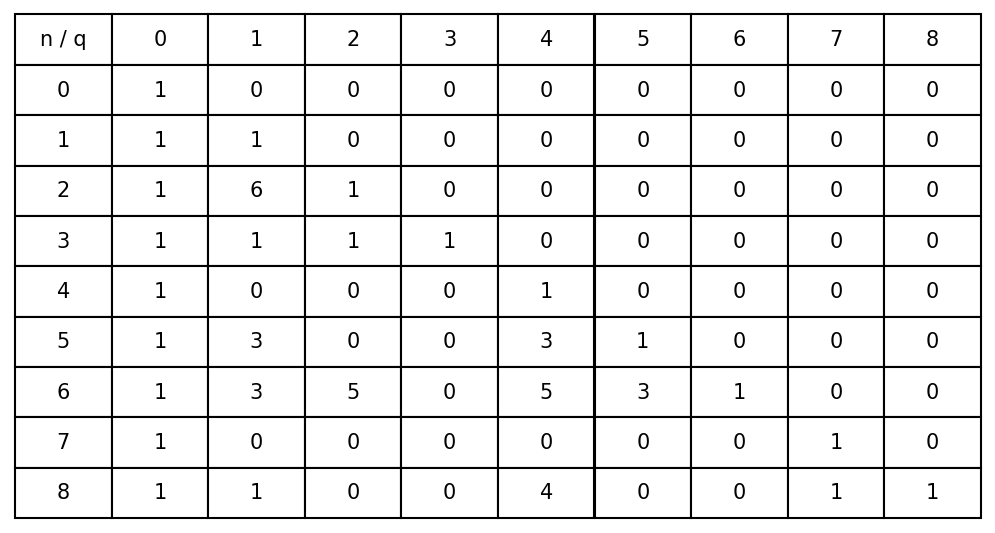
For \(0\leq q\leq n\),
The diagonal coefficient is a unit modulo \(p\):
Proof
Write
Lucas reduction separates the lowest base \(p\) digit and gives
The diagonal case is obtained by setting \(q=n\).
Historical corollary D.26: Standard window integrality
Every coefficient \(C_{mp,j}(n)\) belongs to \({\mathbb Z_p}\).
Proof
The recurrence in Historical theorem D.21 starts with a \(p\) integral constant term. The binomial coefficients are integers, and every diagonal term is a \(p\) adic unit by Historical theorem D.25. Induction gives the result.
Historical corollary D.27: Address independence modulo the prime
Let \(\widetilde e_n^{(m,p)}\) be the reduced standard inverse above. Then
for every \(0\leq j<p\).
Proof
Modulo \(p\), the recurrence in Historical theorem D.21 becomes
This is the defining recurrence for \(\widetilde e_n^{(m,p)}\). The diagonal is one, so the solution is unique.
Historical theorem D.28: Uniform standard window period
Assume that \(p\) is odd and \(m\mid p-1\). Put
Then for every standard window address \(0\leq j<p\),
Proof
By Historical corollary D.27, every address reduces to the same reduced standard inverse. Under the divisibility assumption, that inverse agrees with the compressed Hurwitz inverse by Historical proposition D.11. Its positive tail has period \(h\) by Historical corollary D.12.
Historical corollary D.29: Rational residual generating function
Under the hypotheses of Historical theorem D.28, for every standard address \(j\),
Proof
Combine Historical corollary D.27 and Historical corollary D.13.
Historical theorem D.30: Fourier invariance of the standard window operator
Let \(p\) be odd, let \(m\mid p-1\), and let \(h=(p-1)/m\). Define
Let \(V_h\) be the vector space of sequences satisfying
Then
The restriction of \(T_{m,p}\) to \(V_h\) is an automorphism.
Proof
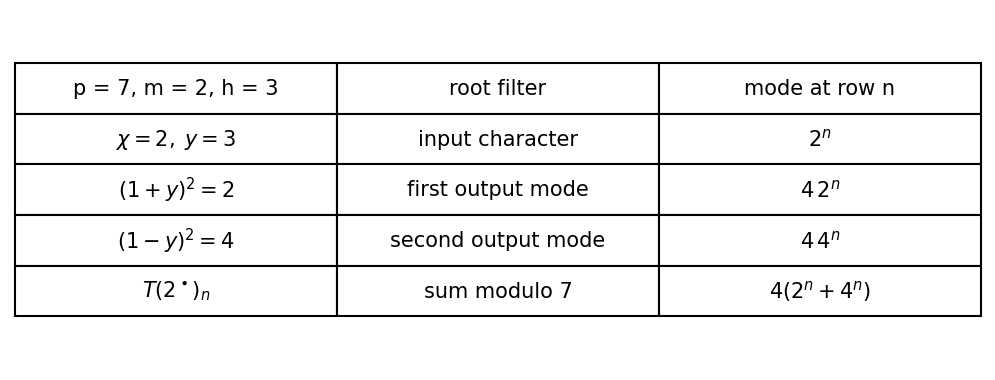
Choose \(d_0=f_h\) and \(d_n=f_n\) for \(n\geq1\). Then \(d\) is fully \(h\) periodic and \(f=d+c\delta_0\) for \(c=f_0-f_h\). Since \(T_{m,p}\delta_0\) is the constant sequence one, it is enough to treat \(d\). Expand
The \(m\)th power map on \({\mathbb F}_p^\times\) has image \(\mu_h\). Choose \(y\) with \(y^m=\chi\). The root filter gives
If \(1+\zeta y=0\), the corresponding term vanishes for positive \(n\). Otherwise
Every summand is therefore \(h\) periodic for positive \(n\). Thus \(T_{m,p}\) preserves \(V_h\). It is unit lower triangular on every finite initial segment. Its restriction to the finite dimensional space determined by \(f_0,f_1,\ldots,f_h\) is injective and hence bijective.
Historical corollary D.31: A second proof of the standard window period
The reduced inverse \(e^{(m,p)}\) and every standard address satisfy the period in Historical theorem D.28.
Proof
The sequence \(\delta=(1,0,0,\ldots)\) belongs to \(V_h\). Its inverse image under the automorphism in Historical theorem D.30 also belongs to \(V_h\). Address independence modulo \(p\) gives the statement for every standard address.
Historical remark D.32
The theorem gives a period modulo \(p\). A period modulo higher powers requires additional control of the triangular inverse and cannot be inferred from the finite field argument alone.