
D.8 Arithmetic lift obstructions
On this page · Permalink · Source line 2505
A congruence class may solve an equation to one precision and fail at the next. The correct obstruction is not an arbitrary residual vector. It is the residual vector modulo the image of the declared correction map.
D.8.1 Linear lifting
On this page · Permalink · Source line 2509
Let \(p\) be a prime. Let
Suppose that \(x_L\in{\mathbb Z_p}^d\) satisfies
for some \(L\geq1\). Define the reduced residual
Write \(\overline M\) for the reduction of \(M\) modulo \(p\).
Historical definition D.84: Linear lift obstruction
The linear obstruction at depth \(L\) is
Historical theorem D.85: One level linear lifting
A class represented by \(x_L\) lifts to a solution modulo \(p^{L+1}\) if and only if
More precisely, a correction \(y\in{\mathbb F}_p^d\) gives a lift
if and only if
When one correction exists, the set of all correction classes is a coset of \(\ker\overline M\).
Proof
Modulo \(p^{L+1}\),
After division by \(p^L\) and reduction modulo \(p\), the lift condition becomes
This equation is solvable exactly when the residual lies in the image of \(\overline M\). If \(y_0\) is one solution, every solution is \(y_0+z\) with \(z\in\ker\overline M\).
Historical proposition D.86: Representative independence
The class \(\operatorname{Ob}^{\mathrm{lin}}_L(x_L)\) depends only on the solution class of \(x_L\) modulo \(p^L\).
Proof
Replace \(x_L\) by \(x_L+p^Lz\). The reduced residual changes by \(\overline Mz\). Its class in the cokernel is unchanged.
Historical corollary D.87: Exact number of linear children
If \(\rho={\operatorname{rank}}_{{\mathbb F}_p}\overline M\), then a solvable depth \(L\) class has exactly
children modulo \(p^{L+1}\).
Proof
The correction set is a coset of a vector space of dimension \(d-\rho\).
Historical example D.88: A visible linear obstruction
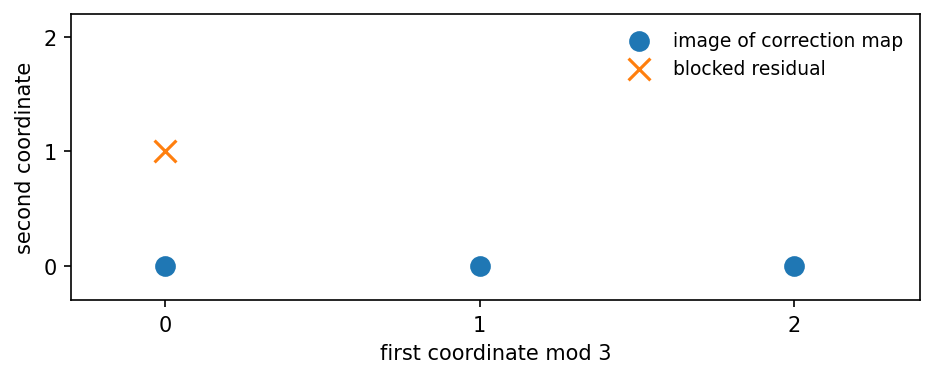
Take \(p=3\), \(L=1\), and
The class \(x_1=(0,0)\) solves
for both
For \(b_1\), the reduced residual is \((1,0)\), which belongs to the image of \(\overline M\). There are three correction classes, given by
For \(b_2\), the residual is \((0,1)\), whose cokernel class is nonzero. No lift modulo nine exists because the second row of \(M\) remains zero.
D.8.2 Polynomial lifting
On this page · Permalink · Source line 2635
Let
be a polynomial map. Editorial coefficient clarification. Here polynomial means \(F_i\in{\mathbb Z}_p[X_1,\ldots,X_d]\), not merely an integer-valued polynomial with coefficients in \({\mathbb Q}_p\). This makes the Jacobian and Taylor remainder integral and their reduction well typed. Suppose
Define
Let \(J_F(x_L)\) denote the Jacobian matrix and write \(\overline J_F(x_L)\) for its reduction modulo \(p\).
Historical definition D.89: Polynomial lift obstruction
The polynomial obstruction at depth \(L\) is
Historical theorem D.90: One level polynomial lifting
Let \(L\geq1\). A class represented by \(x_L\) lifts to a zero of \(F\) modulo \(p^{L+1}\) if and only if
A correction \(y\in{\mathbb F}_p^d\) gives a lift if and only if
When a correction exists, the correction classes form a coset of
Proof
The polynomial Taylor expansion gives
Every term of degree at least two in the increment contains \(p^{2L}\), which is divisible by \(p^{L+1}\). Divide by \(p^L\), reduce modulo \(p\), and apply the same cokernel criterion as in Historical theorem D.85.
Historical proposition D.91: Polynomial representative independence
The class \(\operatorname{Ob}^{F}_L(x_L)\) depends only on the class of \(x_L\) modulo \(p^L\).
Proof
If \(x_L\) is replaced by \(x_L+p^Lz\), Taylor expansion shows that the reduced residual changes by an element of the image of \(\overline J_F(x_L)\). The reduced Jacobian itself is unchanged because \(L\geq1\).
Historical corollary D.92: Simple root lifting
Assume \(r=d\) and
Then the depth \(L\) solution has exactly one child modulo \(p^{L+1}\). Iterating gives a unique \(p\) adic zero above the initial class.
Proof
The reduced Jacobian is invertible, so every residual has one correction. The resulting compatible sequence is Cauchy in \({\mathbb Z_p}^d\), and continuity of \(F\) gives a zero in the limit. Uniqueness holds at every depth.
Historical example D.93: A singular polynomial obstruction
Let \(p=3\) and consider the class \(x_1=0\) modulo three. For
the residual and the reduced derivative both vanish. Every correction \(y\in{\mathbb F}_3\) gives
so the class has three children. For
the reduced derivative is still zero, but the reduced residual is one. Its class in the cokernel is nonzero, so no lift modulo nine exists.
This is the usual simple root mechanism behind Hensel lifting. The obstruction formulation also covers singular Jacobians, where some residual classes lift and others do not [Serre1979], [Gouvea1997], [Robert2000].
D.8.3 Packetwise obstruction splitting
On this page · Permalink · Source line 2737
Historical theorem D.94: Packet decomposition of a lift obstruction
Suppose
and suppose a linear correction map \(D:{\mathbb F}_p^d\to{\mathbb F}_p^r\) satisfies
for every \(a\). Write \(D_a=D|_{U_a}\). Then
A residual lifts if and only if every packet obstruction vanishes.
Proof
The image of \(D\) is the direct sum of the images of the maps \(D_a\). Taking the quotient of the codomain packet decomposition gives the stated cokernel decomposition.
Historical remark D.95
The obstruction theorems solve one declared local lifting step. They do not prove that a compatible branch exists across unrelated primes, that a global Diophantine point exists, or that an arithmetic representation is automorphic.