D.2 Hurwitz series and finite field subgroup inversion
On this page · Permalink · Source line 118
Current status. This dated statement is superseded for the stated divisor-branch family by Theorem 3.7, with the \(j!\) normalization and factorial valuation loss explicitly retained. It makes no claim for unrestricted families.
D.2.1 The Hurwitz ring
On this page · Permalink · Source line 121
Historical definition D.1: Hurwitz series ring
Let \(R\) be a commutative ring with identity. The Hurwitz series ring \({\mathcal H}(R)\) is the set \(R^{{\mathbb N}}\) with componentwise addition and product
Its identity is
When the factorials are invertible, the sequence \(a\) may be written as the exponential generating series
and the Hurwitz product becomes ordinary multiplication. The sequence definition remains valid in every characteristic.
Historical definition D.2: Exponential mode
For \(u\in R\), define
where \(0^0=1\).
Historical proposition D.3: Addition law for modes
For every \(u,v\in R\),
Proof
The \(n\)th coefficient is
by the binomial theorem.
D.2.2 The finite additive group algebra
On this page · Permalink · Source line 173
Let \(p\) be prime. Write \({\mathbb F}_p^+\) for the additive group of the finite field.
Historical theorem D.4: Finite field mode algebra
The map
is an injective algebra homomorphism. Its image is the \(p\) dimensional subalgebra spanned by the modes \(\epsilon_u\).
Proof
The product law follows from Historical proposition D.3. To prove injectivity, suppose
Looking at the coordinates \(n=0,1,\ldots,p-1\) gives a Vandermonde system with matrix
Its determinant is the product of all differences between distinct field elements, so it is nonzero. Hence every \(c_u\) vanishes.
Historical proposition D.5: Augmentation criterion
Let
Then \(x\) is a unit if and only if
is nonzero. If \(J\) is the augmentation ideal, then
Proof
Choose a generator \(g\) of the cyclic additive group. Then
The augmentation ideal is generated by \(y-1\), so its \(p\)th power is zero. Every element has the form \(a+n\) with \(a\in{\mathbb F}_p\) and \(n\in J\). It is invertible exactly when \(a\neq0\), which is the augmentation condition.
Historical corollary D.6: Finite inverse formula
If \(x\) has augmentation one and \(n=x-1\), then
Proof
By Historical proposition D.5, \(n^p=0\). The finite geometric sum gives the inverse.
D.2.3 Subgroup selectors
On this page · Permalink · Source line 248
Fix a divisor \(m\) of \(p-1\). Let
This group has order \(m\).
Historical definition D.7: Multiple selector
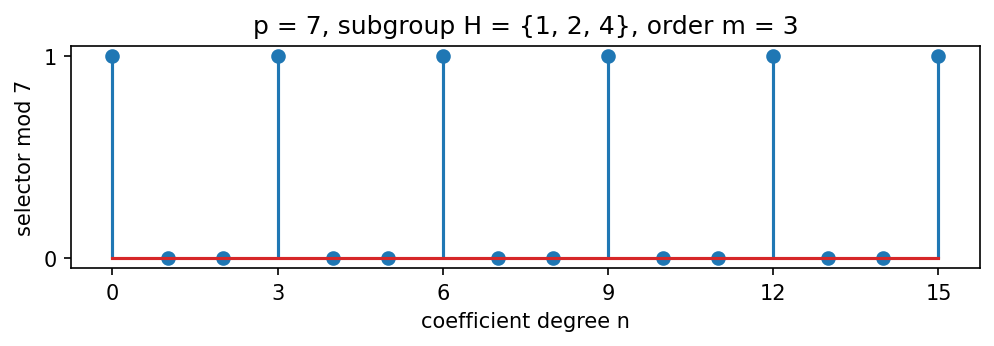
Define \(a^{(m)}\in{\mathcal H}({\mathbb F}_p)\) by
Historical lemma D.8: Subgroup average
The multiple selector has the mode expansion
Proof
The \(n\)th coefficient on the right is
The character sum is one when \(m\mid n\) and zero otherwise.
Since the subgroup average has augmentation one, it has a unique Hurwitz inverse. Write
Historical theorem D.9: Support and positive degree period
The inverse \(b^{(m,p)}\) has the following properties.
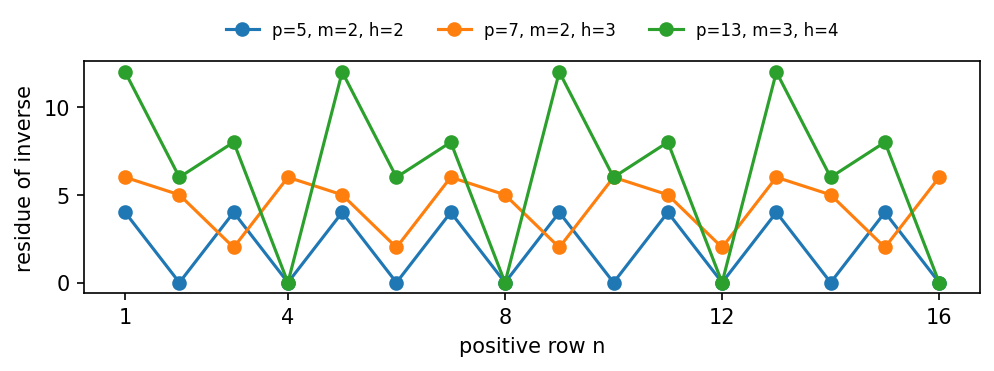
\(b_n^{(m,p)}=0\) unless \(m\mid n\).
For every positive \(n\),
\[ \boxed{ b_{n+p-1}^{(m,p)} = b_n^{(m,p)}. } \]
Proof
Multiplication by an element \(\eta\in H_m\) gives an automorphism of the additive group and therefore an automorphism
of the mode algebra. The selector \(a^{(m)}\) is fixed by every such automorphism, so its unique inverse is fixed as well.
Write
Invariance gives \(c_{\eta u}=c_u\). After the change of variable \(u\mapsto\eta u\),
for every \(\eta\in H_m\). If \(m\nmid n\), some \(\eta\) satisfies \(\eta^n\neq1\), so the coefficient vanishes.
For positive \(n\), the zero mode contributes nothing. Every nonzero mode satisfies \(u^{p-1}=1\). Hence
Historical definition D.10: Compressed inverse
Set
Historical proposition D.11: Compressed inverse recurrence
The compressed coefficients satisfy
In particular, \(e_0^{(m,p)}=1\), and the positive coefficients are determined recursively because the diagonal is one.
Proof
Evaluate the Hurwitz identity
at degree \(mn\). Both factors vanish outside degrees divisible by \(m\). Reindexing the surviving terms gives the displayed recurrence.
Historical corollary D.12: Uniform compressed period
Let
Then
Proof
Since \(m(n+h)=mn+p-1\), the conclusion follows from Historical theorem D.9.
Historical corollary D.13: Rational ordinary generating function
In \({\mathbb F}_p[[z]]\),
Proof
Separate the constant coefficient and group the positive indices into residue classes modulo \(h\).
Historical theorem D.14: Exponential form and minimal period
Let
This cyclic group has order \(h\). There are uniquely determined coefficients \(d_v\in{\mathbb F}_p\), indexed by \(v\in G_m\), such that
The minimal positive period is the least common multiple of the orders of those \(v\) for which \(d_v\neq0\). In particular, it divides \(h\).
Proof
The coefficients \(c_u\) in the proof of Historical theorem D.9 are constant on the cosets of \(H_m\). For \(u\neq0\), the value \(u^m\) depends only on the coset, and every element of \(G_m\) arises. Grouping the modes by cosets gives the displayed expansion.
Distinct elements of \(G_m\) define linearly independent functions on one full period, by the Vandermonde determinant. Therefore a positive integer \(r\) is a period exactly when \(v^r=1\) for every active mode. The least such \(r\) is the stated least common multiple.
Historical example D.15: A compressed inverse modulo seven
Editorial numerical correction. The positive-index standard-window tail printed below is erroneous. The defining recurrence gives \(e_1=-1\equiv6\), \(e_2=5\) and \(e_3=-61\equiv2\pmod7\), so the correct positive tail is \(6,5,2,6,5,2,\ldots\). The period-three conclusion remains correct. The original line is retained only as a corrected historical record. Take \(p=7\) and \(m=2\), so \(h=3\). The recurrence gives
The positive tail has exact period three.