D.5 One local Euler source and kernel calculus
On this page · Permalink · Source line 890
The odd and dyadic reconstructions have one convolutional form. Their sources, kernels, and valuation profiles are different. We first construct each chart and then state the common theorem.
D.5.1 The odd source and its inverse
On this page · Permalink · Source line 894
Let \(q\) be a positive odd integer. Define
Let the signed Euler numbers and Euler zigzag numbers be defined by
and
Historical lemma D.33: Odd source generating function
For every positive odd \(q\),
Its even part is
Proof
The finite geometric sum gives
Averaging at \(t\) and \(-t\) gives the even part.
Historical lemma D.34: Zigzag inverse kernel
Proof
The identity \(\tanh t=-i\tan(it)\) gives the odd zigzag expansion of \(\tanh t\). Differentiate.
Historical theorem D.35: Odd modulus Euler coordinate pair
For every positive odd \(q\) and every even \(n\geq0\),
The inverse transform is
Both transforms are lower triangular with diagonal one.
Proof
The even source identity gives
Insert Historical lemma D.34 and compare coefficients. For the inverse, multiply \(\operatorname{sech}t\) by
Historical corollary D.36: Odd modulus truncation
For every \(M\geq0\), every positive odd \(q\), and every even \(n\),
If \(p\mid q\) and \(a={v_p}(q)\), the same truncation is valid modulo \(p^{2a(M+1)}\).
Proof
Every omitted term contains \(q^{2r}\) with \(r\geq M+1\). The local statement follows by taking the \(p\) adic valuation.
Historical proposition D.37: Odd row weight
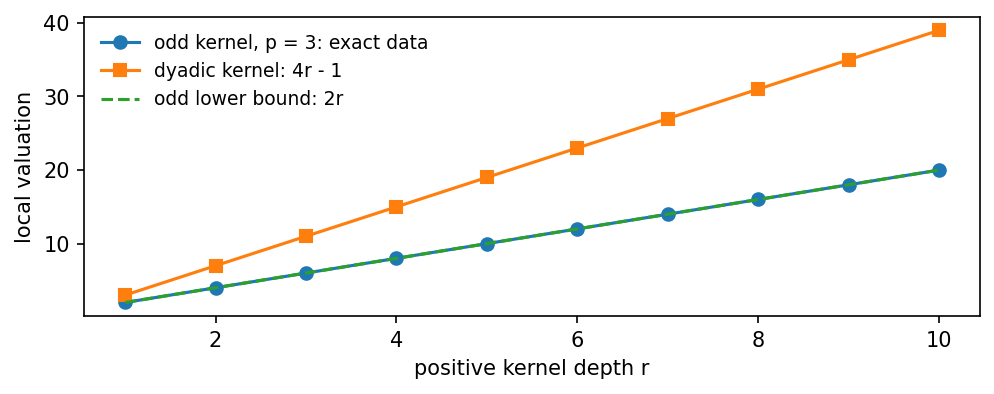
For an odd prime \(p\), the \(r\)th nonzero term in the reconstruction has valuation
The binomial contribution is
where \(s_p\) is the base \(p\) digit sum.
Proof
The first identity separates the valuation of every factor. The second is Legendre's formula, equivalently Kummer's carry theorem [IrelandRosen1990].
D.5.2 The dyadic source and its inverse
On this page · Permalink · Source line 1053
For even \(n\geq0\), define
Its even exponential generating function is
Define \(\beta_r\) by
Historical proposition D.38: Dyadic inverse coefficients
For \(r\geq1\),
Consequently,
Every \(R_n\) is a dyadic unit.
Proof
Differentiate the Bernoulli expansion of \(\coth z\) and use \(-(\coth z)'=\sinh(z)^{-2}\). The von Staudt and Clausen theorem gives \({v_2}(B_{2r})=-1\). Legendre's formula gives
For \(R_n\), put \(k=n+2\). Since \(k\) is even,
The denominator has the same valuation because \(n+1\) is odd.
Historical theorem D.39: Dyadic Euler coordinate pair
For every even \(n\geq0\),
The inverse transform is
Proof
Substitute \(z=2t\) in the inverse series and multiply
Coefficient extraction gives the forward transform. The inverse follows from
D.5.3 The common source and kernel law
On this page · Permalink · Source line 1153
For a prime \(p\), define
and
Historical theorem D.40: Unified local Euler transfer
For every prime \(p\) and every even \(n\geq0\),
If
and
then
For odd \(p\),
For \(p=2\),
Proof
The two source and kernel products were proved in Historical theorem D.35 and Historical theorem D.39. Their divided power coefficient laws have the displayed common form.
Historical theorem D.41: Unified inverse local transfer
Define
Then for every prime \(p\) and every even \(n\geq0\),
Equivalently, if
then
where
for odd \(p\), and
for \(p=2\).
Proof
For odd \(p\), this is the inverse identity in Historical theorem D.35. For \(p=2\), rewrite the inverse identity in Historical theorem D.39 by using
The coefficient becomes
The generating functions are the inverses of the kernels in Historical theorem D.40.
Historical corollary D.42: Exact change between local source charts
Editorial range correction. This comparison holds for the even source subsequences, equivalently the evenized generating functions \(H_p\). It does not identify their full odd-degree source values. For \(p=3\), the original odd source has \(A_{3,1}=S_1(3)=3\), whereas every odd dyadic source coefficient is zero; the even kernel \(L_3K_2\) cannot change that odd coefficient. Read the coefficient consequence below only at even indices. The displayed identity \(H_p=L_pK_\ell H_\ell\) and its proof remain valid. For any two primes \(p\) and \(\ell\), the source sequences \(A_{p,n}\) and \(A_{\ell,n}\) are related by an exact unit lower triangular transformation obtained by composing the inverse kernel \(L_p\) with the reconstruction kernel \(K_\ell\).
Proof
Both source series reconstruct \(\operatorname{sech}t\). Hence
The multiplier has constant coefficient one, so Historical theorem D.16 gives an exact unit lower triangular coordinate change.
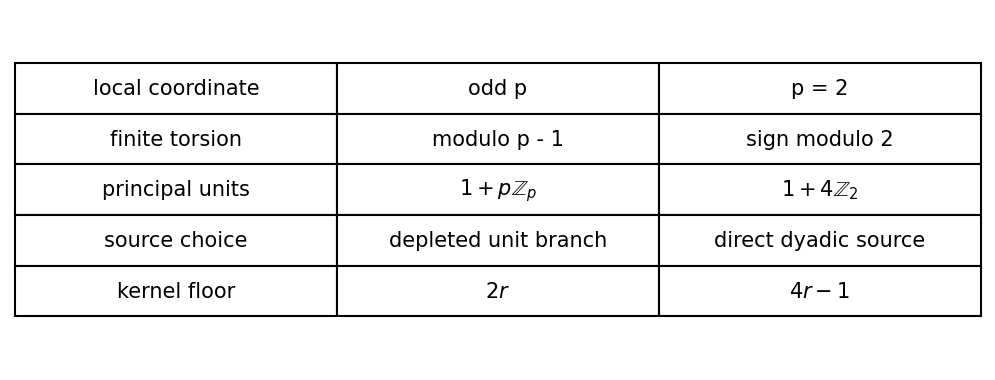
| Feature | Odd prime chart | Dyadic chart |
|---|---|---|
| Finite torsion address | Modulo \(p-1\) | Sign address modulo two |
| Principal units | \(1+p\mathbb Z_p\) | \(1+4\mathbb Z_2\) |
| Source | Alternating odd power sum \(S_n(p)\) | Weighted source \(R_n\) |
| Kernel | \(\operatorname{sech}^2(pt)\) | \(4t^2/\sinh^2(2t)\) |
| Positive depth weight | At least \(2r\), with zigzag and row factors | Exactly \(4r-1\), before the binomial carry |
| Analytic branch | Depleted unit source | Direct integral source |
| Natural refined step | \((p-1)p^a\) | \(2^{a+1}\) |
Historical example D.43: The first odd reconstruction
For \(p=3\) and \(n=2\),
Since \(Z_1=1\), \(Z_3=2\), and \(S_0(3)=1\), the odd coordinate formula gives
The large source value and the depth one correction are both necessary.
Historical example D.44: The first nontrivial dyadic row
For \(n=4\),
The exact kernel coefficients are
Therefore
The rational source values are dyadic units, while the transfer depth is carried by the kernel.
Historical remark D.45
The common convolution does not identify the integral charts. At an odd prime the finite character coordinate has order \(p-1\). At the dyadic prime it begins with the sign coordinate, and the principal unit subgroup begins at \(1+4\mathbb Z_2\).
D.5.4 Exact dyadic transfer depth
On this page · Permalink · Source line 1353
For \(r\geq1\), write
Historical theorem D.46: Exact dyadic kernel weight
Editorial index conventions. The standalone kernel valuation holds for all \(r\ge1\). Its reconstruction-term formula requires even \(n\ge0\) and \(1\le r\le n/2\). In the following truncation formulas only terms with \(r\le n/2\) occur; terms that would use \(R_{n-2r}\) at a negative index are omitted. An empty tail is exactly zero, and the minimum over an empty set of term valuations is \(+\infty\). These conventions include \(M\ge n/2\). For every \(r\geq1\),
The \(r\)th reconstruction term has exact valuation
Equivalently,
Proof
The Bernoulli formula gives \({v_2}(B_{2r})=-1\). The source value is a unit. Kummer's binary carry formula gives the last expression.
Historical theorem D.47: Optimal dyadic truncation
Let
Then
More precisely,
The uniform exponent \(4M+3\) is best possible.
Proof
Every omitted term has valuation at least \(4(M+1)-1\). For optimality, take \(n=2M+2\). There is one omitted term. Its binomial coefficient and source value are one, so its valuation is exactly \(4M+3\).
The first three sharp truncations are