
D.1 Introduction
On this page · Permalink · Source line 29
Euler numbers carry several kinds of local information at once. Their indices have residue addresses. Their coefficient transforms have triangular depth. Their local expansions have Mahler degree. Their congruences depend on the valuation of the transfer kernel and on the valuation of the source value in the row being reconstructed. These pieces should not be merged into one undifferentiated congruence calculation.
This article begins with the Hurwitz product
Over a field of characteristic zero it is multiplication of exponential generating functions. Over a finite field it realizes the additive group algebra through the exponential modes \(\epsilon_u=(u^n)_{n\geq0}\). This finite algebra gives an exact proof of the standard window period. Hurwitz series rings are treated in [Keigher1997], [BarberoCerrutiMurru2018]. The finite difference and umbral background may be found in [Roman1984], [Comtet1974], [GrahamKnuthPatashnik1994].
Fix an odd prime \(p\), a divisor \(m\mid p-1\), and put
The reduced standard window inverse is defined by
We prove that
The result first follows from subgroup symmetry in the finite Hurwitz algebra. A second proof shows that the standard window operator preserves the finite space of sequences that are \(h\) periodic after their constant term. The two arguments expose different parts of the same finite character structure.
The central change in this edition is the treatment of the odd and dyadic Euler formulas. They are no longer presented as unrelated reconstruction devices. For each prime \(p\) we define an even source series \(H_p\) and an inverse kernel \(K_p\) satisfying
At an odd prime,
At the dyadic prime,
The coefficient convolution is identical in form, but the kernels have different integral weights. This is the correct sense in which the local theories unify.
The dyadic kernel is substantially sharper than the separate coefficient bound alone suggests. If
and
then
Consequently, truncation after depth \(M\) is uniformly valid modulo
and this exponent is optimal. The rowwise estimate records the additional binary carries in the binomial coefficient. Classical congruence theory for Euler families is extensive [CarlitzLevine1960], [Young1999], [Young2001], [Sun2008], [Chen2004]. The formulas here are stated as exact coordinate identities. Historical priority requires a separate theorem by theorem comparison.
The second expansion concerns local interpolation. The exponent of the finite unit group moves every unit mode into a principal unit neighborhood. Binomial expansion then gives a Mahler series whose depth \(r\) coefficient gains at least \(Lr\) digits when the chosen jump is the identity modulo \(p^L\). The same argument applies to polynomial exponential modes and to invertible matrix state systems. Mahler interpolation and the Amice transform are classical [Mahler1958], [Amice1964], [Robert2000]. The local unit structure and valuation tools used here are standard [Koblitz1984], [Serre1979], [Washington1997], [Gouvea1997].
The odd Euler source contains one nonunit base. Removing that base gives an analytic unit source and an interpolation of a depleted Euler sequence on every even character branch. The dyadic source is already analytic on \({\mathbb Z_p}\) after a removable singularity is filled. It yields a direct analytic interpolation of \(E_{2n}\) on \(\mathbb Z_2\). These branches are then refined by the substitution
The induced Mahler coefficient transform is finite and explicit. Its kernels compose exactly. At prime power radix they become sparse modulo the residue prime. Every monotone valuation ladder survives the refinement.
The remaining sections treat arithmetic lift obstructions, recurrence packets, and Chinese remainder reconstruction. The lifting obstruction is the residual defect modulo the image of the declared correction map. A recurrence packet is governed by a jump matrix \(C^N\). If one integral recurrence is fixed, all of its local realizations have one common source. These statements do not prove that arbitrary unrelated local objects have a global origin.
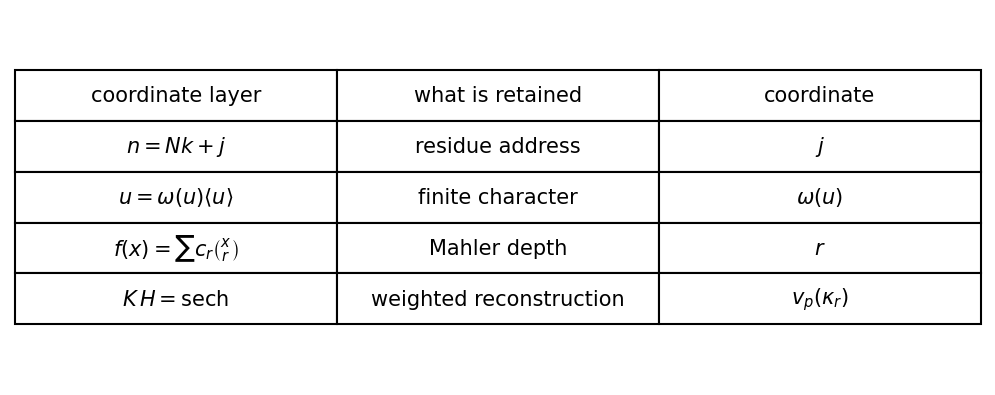
Four boundaries remain explicit. A period modulo \(p\) does not by itself lift to all powers of \(p\). The full finite difference estimate for every congruential reciprocal packet still requires control of the triangular inverse. Exact higher valuations of the affine polyphase kernel are not yet known in general. Chinese remainder reconstruction and finite adelic synchronization do not prove a global source for arbitrary local systems.