
D.7 Polyphase refinement of local Mahler coordinates
On this page · Permalink · Source line 1965
Polyphase refinement replaces one local branch by finitely many digit branches while preserving exact synthesis. For sequences it is residue analysis. For local functions it is the digit tree of \(\mathbb Z_p\). In Mahler coordinates it becomes a finite triangular kernel.
D.7.1 Discrete analysis and exact synthesis
On this page · Permalink · Source line 1969
For a sequence \(a=(a_n)_{n\geq0}\) and \(M\geq2\), define
The analysis map is
Synthesis interleaves the branches by the rule
Historical theorem D.67: Exact discrete polyphase reconstruction
The analysis map \(\mathcal P_M\) is a bijection between sequences and ordered families of \(M\) sequences. If
and
then
Proof
Every nonnegative integer has a unique expression \(Mq+r\) with \(0\leq r<M\). Group the terms of the ordinary generating function by this residue.
Historical theorem D.68: Nested discrete refinement
For positive integers \(M,N\),
For a mixed radix path \((M_1,\ldots,M_\ell)\) with digits \(0\leq s_i<M_i\), the final address is
Only the product radix and accumulated address determine the final branch.
Proof
Direct substitution gives
Iterate this identity along the mixed radix path.
D.7.2 Carry convolution and the shift matrix
On this page · Permalink · Source line 2039
Let \(c=a*b\) be the ordinary Cauchy convolution. Write \(A_r\), \(B_r\), and \(C_r\) for the phase ordinary generating functions.
Historical proposition D.69: One carry convolution law
For every residue \(r\),
The first sum has no phase carry. The second has one coarse index carry.
Proof
Write the input indices as \(Mq+u\) and \(Mq'+v\). Since \(0\leq u,v<M\), their sum has residue \(u+v\) when \(u+v<M\), and residue \(u+v-M\) with one additional coarse index when \(u+v\geq M\).
Historical theorem D.70: Polyphase shift matrix
Let \(E\) be the scalar shift \((Ea)_n=a_{n+1}\), and let \(E_q\) shift the coarse index. Then
where
It also satisfies
Proof
For \(r<M-1\),
For \(r=M-1\),
After \(M\) shifts every phase has advanced by one coarse index.
D.7.3 Local branches and digit reconstruction
On this page · Permalink · Source line 2100
For \(a\geq1\) and \(0\leq s<p^a\), define
Historical theorem D.71: Exact local branch reconstruction
The family \(\{f_{a,s}\}_{0\leq s<p^a}\) determines \(f\) uniquely on \(\mathbb Z_p\). More precisely, if \(y\in s+p^a\mathbb Z_p\), then
For \(a,b\geq1\),
Thus local refinement is exactly the \(p\) adic digit tree.
Proof
The cosets \(s+p^a\mathbb Z_p\) form a disjoint partition of \(\mathbb Z_p\). The first formula is the inverse affine change of variables on one coset. The second follows from
D.7.4 The affine Mahler kernel
On this page · Permalink · Source line 2134
Let
For \(M\geq1\), \(s\geq0\), and \(r,k\geq0\), define
Equivalently,
It vanishes unless
Historical proposition D.72: Edge coefficients of the affine kernel
For every \(M\geq1\), \(s\geq0\), and \(k\geq0\),
For binary radix and zero address,
Hence
Proof
The lowest degree term of \(\Phi_M(z)\) is \(Mz\), and its highest degree term is \(z^M\). Multiplication by \((1+z)^s\) gives the two edge coefficients. When \(M=2\) and \(s=0\),
Taking the coefficient of \(z^{k+j}\) gives the binary formula.
Historical theorem D.73: Mahler polyphase transfer
Let
be a convergent Mahler expansion. For
one has
where
Every refined coefficient uses a finite window of the original Mahler coefficients.
Proof
Use
Taking the coefficient of \(z^r\) gives the affine expansion of \(\binom{Mq+s}{r}\). Since \(c_r\to0\) and every \(d_{s,k}\) uses indices \(r\geq k\), the transformed coefficients also tend to zero.
Historical theorem D.74: Kernel composition
For positive integers \(M,N\),
The sum is finite.
Proof
Apply Historical theorem D.73 first to \(x=Mq+s\) and then to \(q=Ny+t\). The composite substitution is \(x=MNy+Mt+s\). Uniqueness of Mahler coefficients gives the identity.
D.7.5 Valuation transport
On this page · Permalink · Source line 2258
Historical theorem D.75: Polyphase valuation ledger
For every refined coefficient,
If \({v_p}(c_r)\geq w(r)\) for a nondecreasing function \(w\), then
Thus every monotone Mahler precision ladder survives arbitrary polyphase refinement.
Proof
Apply the nonarchimedean triangle inequality to the finite coefficient formula. Since \(r\geq k\), monotonicity gives \(w(r)\geq w(k)\), and the affine kernel is integral.
Historical theorem D.76: Prime power sparsification
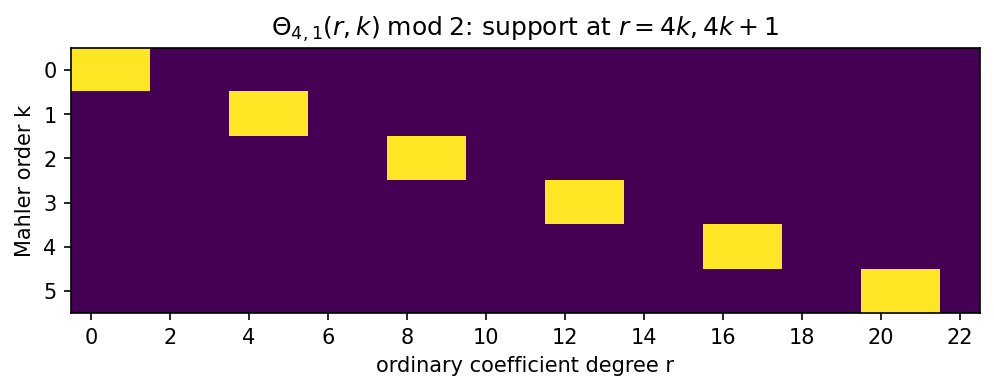
Editorial hypothesis correction. The affine-kernel congruence below needs no change, but its consequence for transformed Mahler coefficients requires \(c_r\in{\mathbb Z}_p\) for every \(r\). Convergence of a \({\mathbb Q}_p\)-valued Mahler expansion alone is insufficient. For \(p=2\), \(M=2\), \(s=0\) and \(f(x)=x/2\), one has \(c_1=1/2\), \(c_2=0\), while \(g(q)=q\) has \(d_1=1\); thus \(d_1\not\equiv c_2\pmod2\). The coefficient consequence is read with integral original coefficients. Let \(M=p^a\). Then
where the binomial coefficient is zero outside its natural range. Consequently,
In particular,
Proof
In characteristic \(p\),
Substitute this congruence in the definition of \(\Theta_{p^a,s}\).
D.7.6 Precision amplification
On this page · Permalink · Source line 2326
Historical theorem D.77: Scalar polyphase precision amplification
Let \(u\in\mathbb Z_p^\times\), let \(a,r\geq0\), and put
Then
For odd \(p\),
For \(p=2\) and odd \(u\),
Equivalently, every additional prime power digit increases the certified Mahler slope by one.
Proof
One difference with step \(H_a\) multiplies the unit mode by \(u^{H_a}-1\). Iterate. The valuation estimates are those of Historical corollary D.53.
Historical lemma D.78: Matrix power amplification
Editorial hypothesis correction. Require \(L\ge1\). At \(L=0\) the standalone claim is false: for \(p=3\), \(d=1\) and \(X=2=1+B\), one has \(X^3-1=7\notin3{\mathbb Z}_3\). With \(L\ge1\), every higher binomial term in the retained proof has the required valuation, including \(p=2\). If
with \(B\in M_d({\mathbb Z_p})\), then for every \(a\geq0\) there is \(B_a\in M_d({\mathbb Z_p})\) such that
Proof
Induct on \(a\). Expand the \(p\)th power of \(I+p^{L+a}B_a\). The linear term has valuation at least \(L+a+1\), and every higher term has at least that valuation.
Historical theorem D.79: Matrix polyphase precision amplification
Editorial hypothesis correction. Require \(L\ge1\), \(C,B\in M_d({\mathbb Z}_p)\), \(v_0,w\in{\mathbb Z}_p^d\), \(H>0\), and \(a,j,n,r\in{\mathbb N}\). These are the hypotheses of the two corrected matrix statements used by the retained proof. Without integral observation vectors or positive \(L\), the preceding counterexamples invalidate the claimed precision. Assume
Put \(H_a=Hp^a\). Then
for an integral matrix \(B_a\). Every refined packet
has Mahler coefficients satisfying
Equivalently,
Proof
Combine Historical lemma D.78 and Historical theorem D.55.
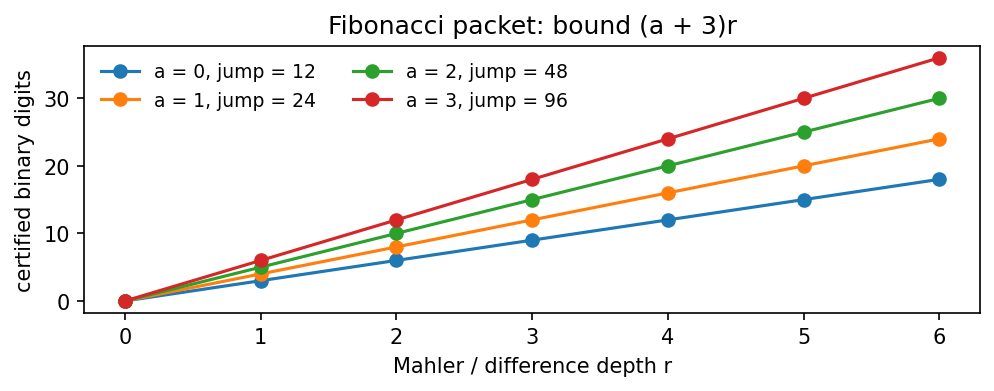
Historical example D.80: Refined dyadic Fibonacci ladder
For the Fibonacci companion matrix
one has
Therefore
Every dyadic refinement doubles the step and adds one guaranteed binary digit at each Mahler depth.
D.7.7 Character and polyphase coordinates
On this page · Permalink · Source line 2450
For odd \(p\), write
with \(0\leq j<p-1\) and \(0\leq s<p^a\). The address \(j\) records the finite character. The address \(s\) records the principal unit digit. The variable \(q\) carries the remaining Mahler expansion.
At the dyadic prime, write
with \(j\in\{0,1\}\) and \(0\leq s<2^a\). The sign coordinate replaces the odd prime character coordinate.
Historical proposition D.81: Local phase lattice
For a unit mode \(u^n\), the odd prime coordinate gives
The dyadic coordinate gives
Thus finite character phase, local digit address, and Mahler depth are separate coordinates.
Proof
Substitute the two displayed decompositions of \(n\).
Historical corollary D.82: Polyphase refinement of the Euler branches
The analytic branches in Historical theorem D.62 and Historical theorem D.65 admit exact refinements under \(x=p^aq+s\). Their refined Mahler coefficients are obtained from \(\Theta_{p^a,s}\). The original monotone valuation ladders are preserved, and unit mode or invertible matrix representations gain one certified digit per refinement level.
Proof
Apply Historical theorem D.73, Historical theorem D.75, Historical corollary D.53, and Historical theorem D.79.
Historical remark D.83
Exact refinement does not imply that every branch is simpler. A simplification theorem requires an additional invariant, such as Frobenius sparsity, valuation gain, spectral collision, or a vanishing transfer block.