
11 A worked arithmetic atlas
On this page · Permalink · Source line 1
The examples below retain the infinite definition while calculating only the finite coordinates that a particular operation needs. They make the cocycle and the root certificates visible.
11.1 The empty selector
On this page · Permalink · Source line 5
Take \(A=\varnothing\). The selected primes are
namely the even-indexed primes. The first coordinates of three rational lifts are
| \(p\) | 2 | 3 | 5 | 7 | 11 | 13 |
|---|---|---|---|---|---|---|
| \(u_A=s_A(1)\) | 1 | 0 | 1 | 0 | 1 | 0 |
| \(s_A(1/2)\) | 0 | 0 | 3 | 0 | 6 | 0 |
| \(s_A(1/3)\) | 1 | 0 | 2 | 0 | 4 | 0 |
Each residue is exact. At \(p=2\), the lift of \(1/2\) is set to zero because the denominator is not invertible. At \(p=5\), its value is \(3\) because \(2\cdot3=1\) in \({\mathbb F}_5\).
Doubling the half-lift agrees with \(u_A\) at every prime except \(2\). Therefore
The element \(u_A\) has no half in the group: there is no \(y\) with \(2y=u_A\), because its \(2\)-coordinate is nonzero. The apparent candidate \((1/2,0)\) misses by precisely the certificate coordinate.
At the unselected prime \(3\), the coordinate of \(u_A\) is zero. In this case
The three roots are
Their differences form \(G_A[3]=C_3\), as predicted by Proposition 6.2.
11.2 A successful composite-root calculation
On this page · Permalink · Source line 38
Let
Its coordinate at \(2\) is \(1+1=0\), and its coordinate at \(3\) is zero. Thus the multiplier \(6\) has no obstructing coordinate.
The rational candidate is \(t=1/6\). At a selected prime other than \(2\), multiplication by \(6\) recovers the coordinate of \(u_A\) because the denominator is invertible, except possibly at \(3\), which is unselected. At \(2\), both sides are zero. Hence
Every other root is obtained by adding an arbitrary element of \(C_2\oplus C_3\). There are exactly six roots. This calculation exhibits a positive certificate without searching an unbounded domain.
Now contrast \(u_A\) itself. The same multiplier \(6\) fails at the prime \(2\). No change at the \(3\)-coordinate and no choice of rational representative can repair that obstruction while keeping the target fixed.
11.3 A torsion correction that cannot be discarded
On this page · Permalink · Source line 53
Take the purely torsion target \(e_3\) and multiplier \(2\). The root criterion succeeds because the target has zero \(2\)-coordinate. Its rational part is zero, but the answer is not the zero element:
In \({\mathbb F}_3\), multiplication by \(2\) sends \(2\) to \(1\). This is the simplest example showing why the finite correction in the root algorithm is necessary even when the rational coordinate causes no difficulty.
11.4 Finite quotient representatives
On this page · Permalink · Source line 60
For any target \(g\) and positive multiplier \(m\), define the finite vector
Then \(g-d_m(g)\) has zero coordinates at every prime dividing \(m\). The root theorem provides a witness that it belongs to \(mG_A\). Thus \(d_m(g)\) is an exact finite representative of the coset of \(g\).
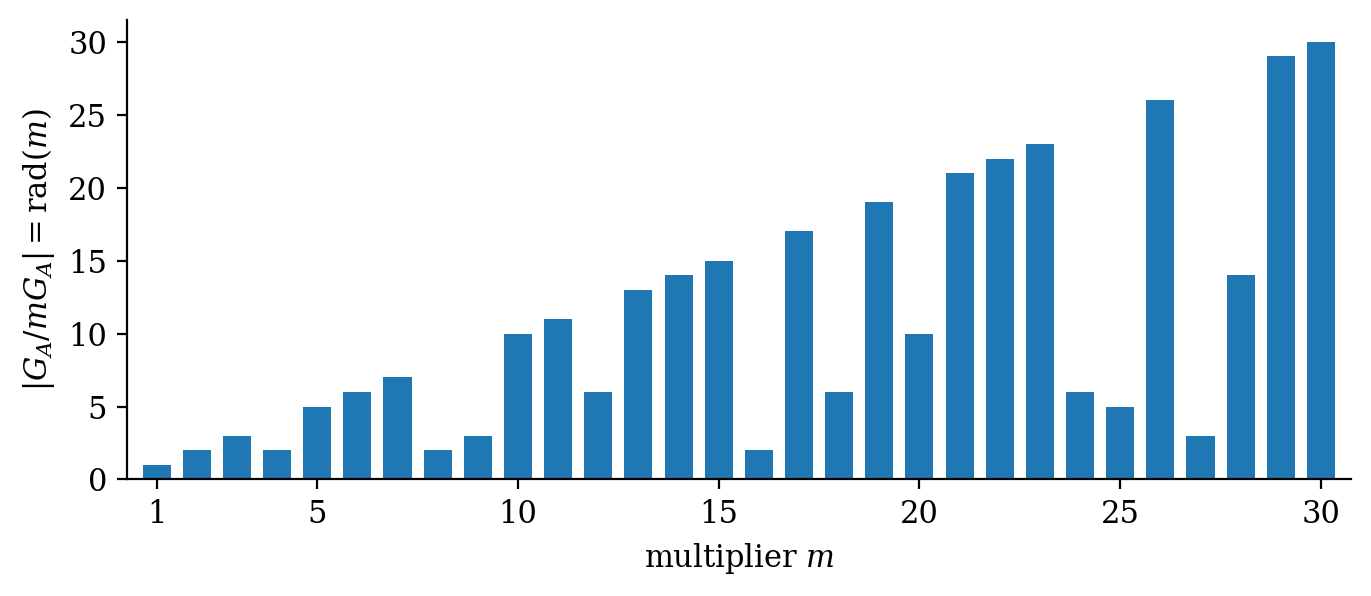
For \(m=12\), only coordinates \(2\) and \(3\) matter. The six representatives are
The vector \(e_2+e_3\) generates this quotient, which is \(C_6\), not \(C_{12}\). Repeated prime powers in the multiplier do not create additional coordinates.
11.5 Changing one selector bit
On this page · Permalink · Source line 79
Let \(B=\{0\}\), so the first pair changes from selecting \(2\) to selecting \(3\). The groups \(G_A\) and \(G_B\) are equal as subgroups of \(P\). Their half-lift coordinates differ, however:
At \(p=2\), both half-lifts are zero. At \(p=3\), the \(B\) lift is \(2\), so its negative is \(1\). Therefore the same ambient element has normal forms
Doubling the right-hand side in the \(B\) group gives
which is the transported form of \((1,e_2)_A\). The correction in (7.1) is required to compare the two group laws. Merely reusing the same pair \((r,d)\) under a new selector changes the represented element.
11.6 A finite tail exception
On this page · Permalink · Source line 94
Consider an infinite-order element
An exception set for its signature is \(\{2,3,5,7\}\). Outside these primes, the denominator is invertible, the numerator is nonzero, and the torsion correction vanishes. Thus the root pattern of \(x\) agrees with that of \(u_A\) in every later prime pair.
This example illustrates the nonuniform step in Theorem 8.3. In known normal-form coordinates the exception set is computable. In an arbitrary unmarked copy, a reduction may use a finite exception bound without uniformly discovering it from the copy.
11.7 Reproducing the examples
On this page · Permalink · Source line 103
From the package root, the following uses the supplied standard-library implementation:
from fractions import Fraction
from src.dense_lift_groups import DenseLiftGroup, Element

G = DenseLiftGroup(lambda n: False)
u = Element.make(1)
half = Element.make(Fraction(1, 2))

assert G.scale(2, half) == Element.make(1, {2: 1})
assert G.root(u, 2).obstructing_prime == 2
third = G.root(u, 3).root
assert third is not None and G.scale(3, third) == u

x = Element.make(1, {2: 1})
sixth = G.root(x, 6).root
assert sixth is not None and G.scale(6, sixth) == xOnly computable selector examples are executed. A callable supplied as an oracle is assumed to return the correct selector bit. The implementation does not pretend to evaluate the halting set or an arbitrary noncomputable parameter.