
2 The squarefree ambient system
On this page · Permalink · Source line 1
One sequence of finite cyclic groups has two natural limits. Their generation properties differ because the connecting maps and the permitted elements differ.
2.1 Finite stages and two connecting systems
On this page · Permalink · Source line 5
For \(N\ge1\), define
The Chinese remainder map sends \(k\bmod m_N\) to \((k\bmod p_i)_{i<N}\). It is an isomorphism, so \(A_N\) is cyclic and its all-one vector is a generator.
| \(N\) | Prime factors | \(m_N\) | Finite group |
|---|---|---|---|
| 1 | \(2\) | 2 | \(C_2\) |
| 2 | \(2,3\) | 6 | \(C_6\) |
| 3 | \(2,3,5\) | 30 | \(C_{30}\) |
| 4 | \(2,3,5,7\) | 210 | \(C_{210}\) |
| 5 | \(2,3,5,7,11\) | 2310 | \(C_{2310}\) |
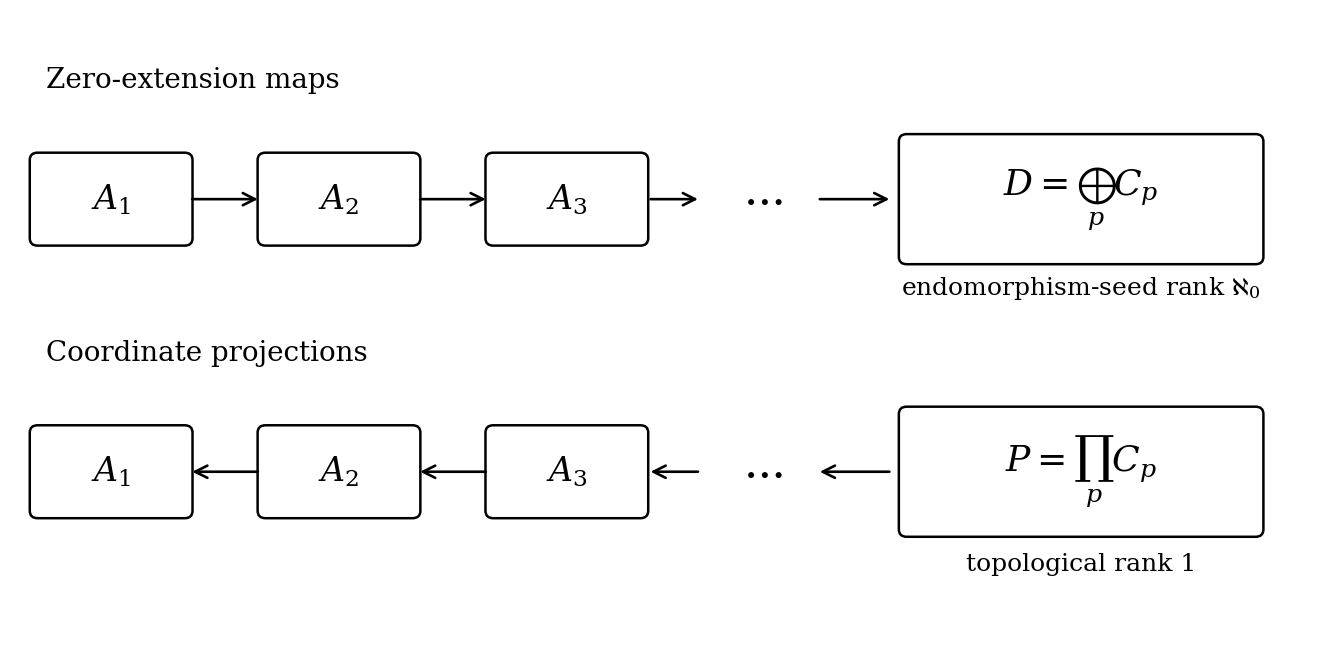
Zero extension gives injections \(A_N\to A_{N+1}\). Forgetting the last coordinate gives surjections \(A_{N+1}\to A_N\). These are different diagrams. Their limits are
The first group contains only finite-support vectors. The second contains arbitrary compatible coordinate assignments.
Give each \(C_p\) its discrete topology and give \(P\) the product topology. A basic neighborhood fixes only finitely many coordinates. We give every subgroup of \(P\) the induced topology when discussing topological generation, unless explicitly stated otherwise.
2.2 Torsion and endomorphisms
On this page · Permalink · Source line 34
Theorem 2.1: The torsion subgroup of the product
The subgroup \(D\) is dense and proper in \(P\), and
Proof
A prescribed finite coordinate pattern is realized by a finite-support vector. Thus \(D\) meets every basic open set and is dense. A finite-support vector is annihilated by the product of the finitely many primes in its support, so it is torsion.
Conversely, suppose \(mx=0\) for a positive integer \(m\). Whenever \(p\nmid m\), multiplication by \(m\) is invertible in \(C_p\), and hence \(x_p=0\). The support of \(x\) is contained in the finite set of prime divisors of \(m\). Thus \(x\in D\). The all-one vector has infinite support, so it belongs to \(P\setminus D\).
Proposition 2.2: Diagonal endomorphisms of the direct sum
Every endomorphism of \(D\) acts by a scalar on each prime coordinate, and
as rings.
Proof
The subgroup annihilated by a prime \(p\) is exactly the \(C_p\) coordinate. Every endomorphism preserves it, because \(px=0\) implies \(pT(x)=T(px)=0\). Its restriction to that cyclic group is multiplication by a unique scalar in \({\mathbb F}_p\). An arbitrary element of \(D\) is a finite sum of such primary elements, so these restrictions determine the map. Conversely, any family of coordinate scalars preserves finite support and defines an endomorphism. Addition and composition correspond to coordinate addition and multiplication.
Corollary 2.3: An infinite seed obstruction
The endomorphism-seed rank of \(D\) is \(\aleph_0\). No finite set topologically generates \(D\), even after all endomorphisms are admitted.
Proof
The union of the supports of finitely many seeds is finite. Diagonal endomorphisms preserve its complement as zero coordinates. Any omitted coordinate projection is a certificate from Theorem 1.8. Its kernel is closed in the induced topology, so taking closure does not help. The countably many vectors \(e_p\) generate \(D\) algebraically, proving the exact rank.
Notice that this conclusion does not depend on restricting the number of endomorphisms. Even the full endomorphism ring cannot create a missing prime component from the available seeds.
2.3 A single topological generator after completion
On this page · Permalink · Source line 69
Theorem 2.4: Topological cyclicity
Let \(u=(1,1,1,\ldots)\in P\). Then
In particular, \({\operatorname{trank}}(P)=1\).
Proof
A basic open set prescribes a tuple on finitely many distinct prime coordinates. The Chinese remainder theorem supplies an integer \(k\) with the specified residues. The element \(ku\) belongs to the given open set. Therefore the cyclic subgroup is dense. The product is nontrivial, so zero generators do not suffice.
The generator \(u\) is absent from \(D\). The topological statement does not exhibit a finite generating family inside the original dense subgroup. This is the precise mechanism by which completion changes the generation contract.
2.4 The complete finite-quotient system
On this page · Permalink · Source line 89
Proposition 2.5: Profinite completion of the direct sum
The canonical embedding of \(D\) into \(P\) identifies \(P\) with \(\widehat D\).
Proof
Let \(f:D\to F\) be a homomorphism to a finite group. The image of a prime-order factor \(C_p\) is trivial unless \(p\) divides \(\lvert F\rvert\). Thus \(f\) vanishes on all but finitely many prime components and factors through a finite coordinate product. Kernels of finite coordinate projections are therefore cofinal among the finite-index normal subgroups of \(D\). Taking their inverse limit gives exactly \(P\), with the canonical map supplied by the coordinates.
This proof does not assume that \(F\) is abelian. The image is abelian because the source is, and the order argument applies to each factor. The definition and general properties of profinite completion may be found in [5]. All needed cofinality statements in this book are proved for the specific groups under consideration.
2.5 A rational space behind the torsion
On this page · Permalink · Source line 99
Put \(V=P/D\) and let \(q:P\to V\) be the quotient map.
Theorem 2.6: Unique division in the ambient quotient
Multiplication by every positive integer is bijective on \(V\). Thus \(V\) has a unique rational vector-space structure extending its additive group structure. The product \(P\) has no nonzero divisible subgroup.
Proof
Fix \(m\ge1\) and \(x\in P\). Define \(y_p=m^{-1}x_p\) when \(p\nmid m\), and \(y_p=0\) when \(p\mid m\). Then \(x-my\) has finite support. Thus \(q(x)=m q(y)\), proving surjectivity on \(V\).
For injectivity, suppose \(mx\in D\). Outside the union of the finite support of \(mx\) and the prime divisors of \(m\), multiplication by \(m\) is invertible and \(x_p=0\). Hence \(x\in D\) and \(q(x)=0\). Unique division defines \((a/b)v\) as the unique solution \(w\) of \(bw=av\). The vector-space laws follow by clearing positive denominators and using injectivity of integer multiplication.
Finally, a homomorphism from a divisible group to \(C_p\) is zero. For each source element \(x\), write \(x=py\) and observe that its image is \(p\) times an element of \(C_p\). Every coordinate of a divisible subgroup of \(P\) therefore vanishes, so that subgroup is zero.
A group with no nonzero divisible subgroup is called reduced. Thus \(P\), and every subgroup of \(P\), is reduced. Nevertheless \(P/D\) is divisible. Quotients can possess division that no subgroup of the original group supports. The nonsplitting theorem later turns this distinction into an exact obstruction.