
5 The paired-prime groups
On this page · Permalink · Source line 1
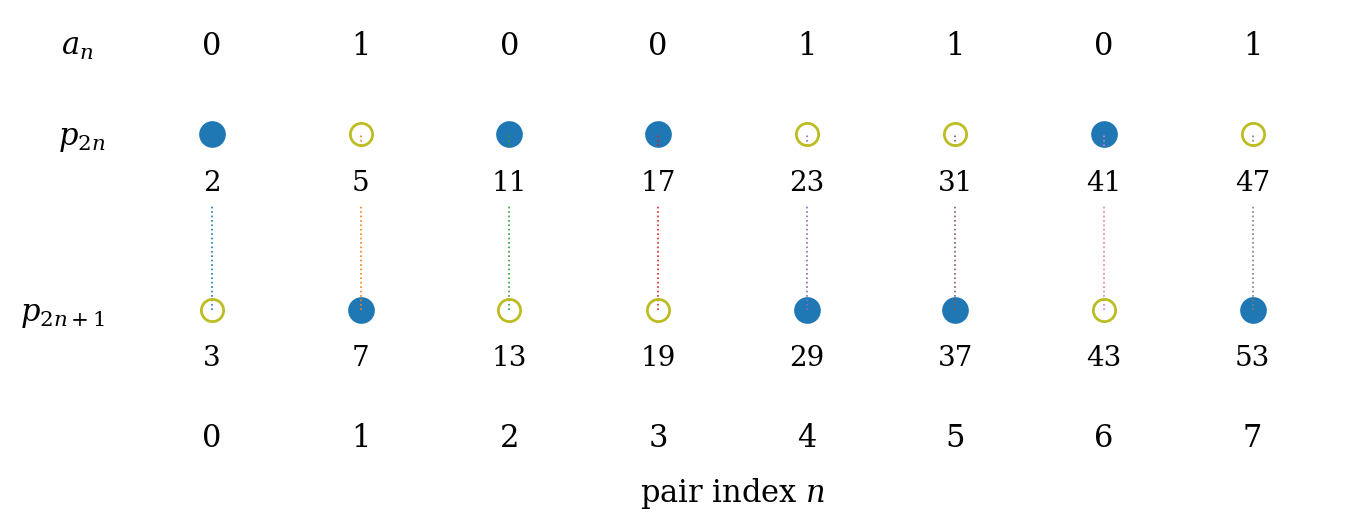
A binary selector chooses one prime from each pair. Its indicator determines a rational line in the ambient quotient, and an explicit finite cocycle turns that line into a countable group.
5.1 Choosing a rational line
On this page · Permalink · Source line 5
Let \(A\subseteq{\mathbb N}\), write \(a_n={\mathbf 1}_A(n)\), and define
Exactly one prime from each pair is selected. Both \(S_A\) and its complement are infinite. Let \(u_A\in P\) be its indicator:
Because \(u_A\) has infinite support, \(q(u_A)\ne0\). We can therefore define a rational line and its preimage by
This definition produces an actual group for every set \(A\). It does not claim an effective method for obtaining the selector bits of an arbitrary \(A\).
5.2 A section with finite arithmetic defects
On this page · Permalink · Source line 26
For a reduced rational \(r=a/b\), with \(b>0\), define
The inverse is used only when the denominator is a unit in \({\mathbb F}_p\). The convention at denominator primes is essential. It is a choice of representatives, not a claim that division by \(p\) is defined in \(C_p\).
The difference \(b s_A(a/b)-a u_A\) is supported on the prime divisors of \(b\). It follows that
Thus every element of \(G_A\) is \(s_A(r)+d\) for some \(r\in{\mathbb Q}\) and \(d\in D\).
Theorem 5.1: Unique normal form
Every element of \(G_A\) has a unique expression
Consequently \(G_A\) is countably infinite, with a countable normal-form domain that does not depend on the selector.
Proof
Existence follows from the preimage definition and the displayed quotient identity. If two forms are equal, applying \(q\) gives \((r-r')q(u_A)=0\). The vector \(q(u_A)\) is nonzero in a rational vector space, so \(r=r'\). The finite-support terms are then equal. Both \({\mathbb Q}\) and \(D\) are countable, while the quotient is the infinite group \({\mathbb Q}\).
The domain can be named without knowing \(A\). The group operation on those names will contain the selector information.
5.3 The cocycle law
On this page · Permalink · Source line 57
Define
The sum is taken in \(P\), but its value belongs to \(D\).
Lemma 5.2: A finite support bound
For all \(r,t\in{\mathbb Q}\),
Proof
At a prime not dividing either denominator, all three rationals have well-defined reductions. On a selected coordinate, reduction respects addition, so the defect is zero. On an unselected coordinate, all section values are zero. The reduced denominator of \(r+t\) has no prime divisor absent from the two original denominators.
Theorem 5.3: Explicit group law
In normal-form coordinates, addition is
The identity is \((0,0)\) and the inverse of \((r,d)\) is \((-r,-d)\). The law is associative and commutative, and the map \((r,d)\mapsto s_A(r)+d\) is an isomorphism onto the subgroup \(G_A\le P\).
Proof
Substitution into addition in \(P\) gives the formula. The section satisfies \(s_A(0)=0\) and \(s_A(-r)=-s_A(r)\), so \(c_A(r,0)=0\) and \(c_A(r,-r)=0\). These identities give the stated identity and inverse.
Symmetry is immediate. The cocycle equation
follows by expanding and cancelling the section terms. Expanding the two associations in (5.2) now proves associativity. Uniqueness of normal forms makes the ambient map bijective, and the addition formula makes it a homomorphism.
This is the standard symmetric cocycle construction of an abelian extension [4], Section 3.2. Here the particular section makes each individual correction finitely supported and exactly computable from finitely many selector queries.
Proposition 5.4: One cocycle value reads one coordinate
For every prime \(p\),
Proof
The support bound leaves only the coordinate \(p\). At that coordinate both fractional lifts are zero, and the lift of their sum, which is one, is \({\mathbf 1}_{S_A}(p)\).
Dropping the cocycle is therefore not a harmless simplification. The direct product operation on \({\mathbb Q}\times D\) removes exactly these defects and gives a different, split extension.
5.4 Structure of the extension
On this page · Permalink · Source line 108
By Chapter 4, the group is pure in \(P\), reduced, residually finite, and dense. Its torsion is \(D\), and the rational coordinate gives the exact sequence
It does not split.
There is an equivalent cocycle obstruction. Suppose a function \(b:{\mathbb Q}\to D\) modified the section to an additive map \(r\mapsto s_A(r)+b(r)\). Then
for every \(r,t\). The modified section would split (5.3). Hence no such function exists. The cocycle is the defect of a section into \(P\), but it is not removable by a correction valued in \(D\).
Proposition 5.5: Finitely generated subgroups
Every finitely generated subgroup of \(G_A\) is either finite cyclic or isomorphic to \({\mathbb Z}\oplus C_m\) for a squarefree positive integer \(m\), with \(C_1\) trivial.
Proof
Let \(L\le G_A\) be generated by finitely many elements. Its image in \({\mathbb Q}\) is a finitely generated subgroup of \({\mathbb Q}\), hence either zero or infinite cyclic. If it is zero, then \(L\le D\) and its finite support places it inside a finite cyclic group.
Otherwise choose a lift \(x\in L\) of a generator of its rational image. Subtracting suitable integer multiples of \(x\) from the given generators produces finitely many elements of \(D\). They generate the kernel of \(L\to\rho_A(L)\), which is finite cyclic of squarefree order. The subgroup \(\langle x\rangle\) intersects that torsion kernel trivially, giving the direct sum.
The extensions over finitely generated rational images split, but the extension over all of \({\mathbb Q}\) does not. This is another exact distinction between finite algebraic stages and the global realization.