
10 Escaping a fixed finite grammar
On this page · Permalink · Source line 1
A relative diagonal argument can be carried out entirely inside one common-completion class. Because finite selector changes leave the group unchanged, the diagonal must disagree infinitely often.
10.1 Fix the semantics before diagonalizing
On this page · Permalink · Source line 5
Let \(\mathfrak G\) be a grammar with countably many finite, parameter-free descriptions. Each valid description has one group isomorphism type as its semantics. Enumerate the strings as
and write \(R_j\) for the semantic output. Invalid strings may be assigned a fixed dummy group. No decidability assumption is made about validity or evaluation.
For each \(j\) whose output lies in the family, choose \(B_j\subseteq{\mathbb N}\) such that \(R_j\cong G_{B_j}\). For other \(j\), set \(B_j=\varnothing\). This is a set-theoretic choice of representatives. It is not a procedure for deciding whether an arbitrary description denotes a group in the family.
The isomorphism criterion says that a selector must avoid the whole eventual-equivalence class of \(B_j\), not merely disagree at one coordinate. A naive Cantor diagonal with one disagreement for each \(j\) would not establish that requirement.
10.2 Repeated diagonal coding
On this page · Permalink · Source line 16
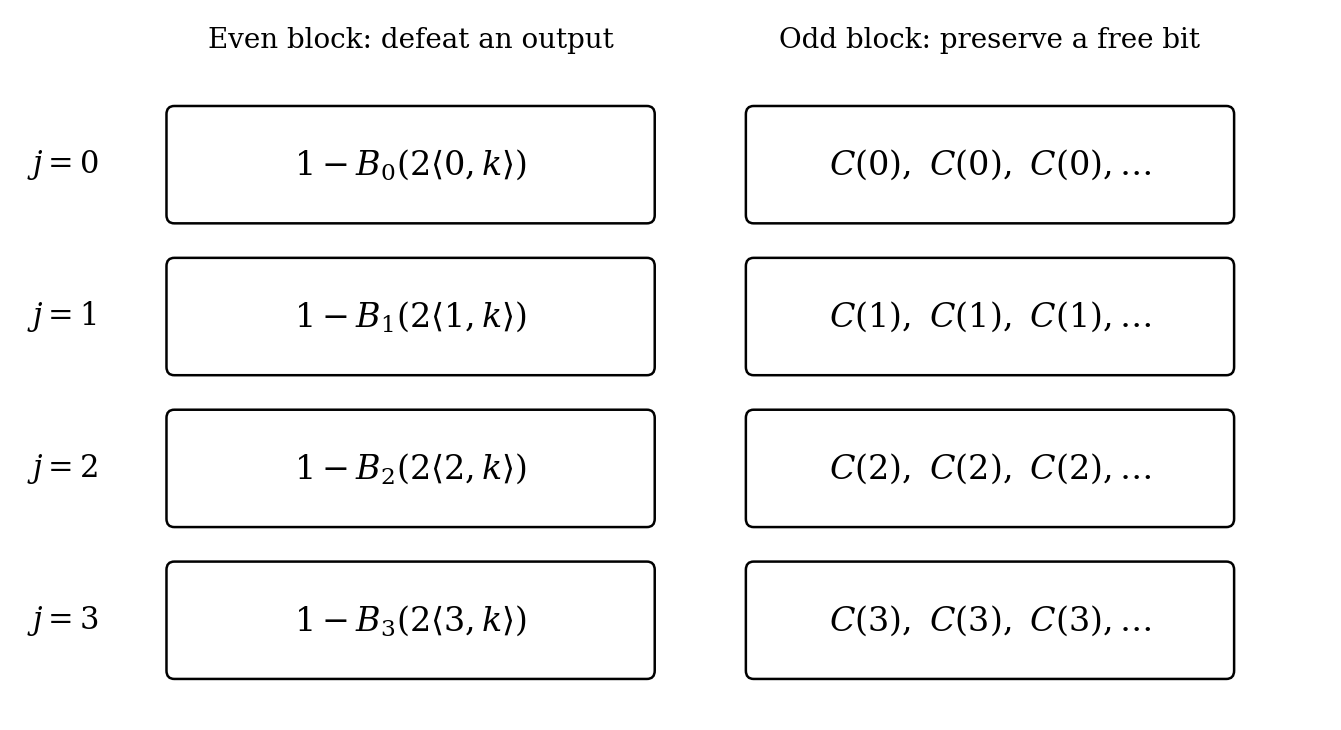
Fix a computable pairing bijection \(\langle j,k\rangle:{\mathbb N}^2\to{\mathbb N}\). For a freely chosen set \(C\subseteq{\mathbb N}\), define a new selector \(A_C\) by
Every natural number has exactly one of these forms, so the rules define a total subset. The even positions defeat grammar outputs. The odd positions retain an independent continuum of choices, with each chosen bit repeated infinitely often.
Theorem 10.1: Escape within one profinite-completion class
For every \(C\subseteq{\mathbb N}\), the group \(G_{A_C}\) is not isomorphic to any output of \(\mathfrak G\). Distinct \(C\) give pairwise nonisomorphic groups, with no embeddings in either direction. Every group is countable, reduced, residually finite, and has profinite completion \(P\).
Proof
Fix a description index \(j\). If \(R_j\) is outside the family, it cannot be isomorphic to \(G_{A_C}\). Otherwise rule (10.1) makes \(A_C\) disagree with \(B_j\) at every index \(2\langle j,k\rangle\). These are infinitely many distinct indices, so \(A_C{\ne^{*}} B_j\). Theorem 7.2 excludes the isomorphism.
If \(C\ne C'\), choose \(j\) at which they differ. Rule (10.2) makes \(A_C\) and \(A_{C'}\) differ at infinitely many odd indices. Theorems 7.2 and 7.6 then give nonisomorphism and nonembeddability. The remaining properties hold for every paired-prime group.
10.3 The complexity consequence
On this page · Permalink · Source line 42
The theorem implies
for every \(C\). It produces continuum many distinct isomorphism types outside the grammar while preserving all the finite quotient data.
This is a statement relative to a specified language and semantics. The definition of \(A_C\) may use the entire semantic table of that language in the surrounding mathematical theory. It does not yield an effective evaluator for the table. Nor does it produce a paradox by defining in one paragraph an object claimed to be beyond every possible finite definition. The object escapes the fixed internal grammar, not all larger metatheories.
The same distinction applies to a language extended by a new constant. A constant naming one previously absent group enlarges the language. If it is only a semantic constant, it need not give algorithms for that group's operations. A new realization rule must be assessed under its actual semantic and effective contract.
10.4 Monotonicity under grammar extension
On this page · Permalink · Source line 53
Proposition 10.2: Admissible expansion
Suppose every valid description in \(\mathfrak G\) translates to a valid description in \(\mathfrak H\) with the same semantic group. Then every \(\mathfrak G\)-realizable group is \(\mathfrak H\)-realizable. If every translated description has length at most \(f(\lvert d\rvert)\), then
whenever \(K_{\mathfrak G}(G)\) is finite.
Proof
Translate a shortest valid \(\mathfrak G\) description of \(G\). Its semantic output remains \(G\), and its length has the stated bound.
An obstruction to a small grammar can therefore disappear after an admissible expansion. The power-of-two selector from Chapter 3 illustrates this concretely: a unary finite-state selector fails, while a binary one succeeds. Such a result characterizes a boundary rather than discrediting the larger realization program.
10.5 Uniform families and individual instances
On this page · Permalink · Source line 67
The expression \(A\mapsto G_A\) is one uniform mathematical construction. It is not a finite description of each arbitrary instance unless the selector is also described. A single family can contain uncountably many values even though a parameter-free finite syntax has only countably many strings.
For computable selectors, a program for \(A\) provides a finite effective input to the normal-form construction. For noncomputable but finitely definable selectors, one obtains a finite semantic description without an effective copy. For selectors outside a chosen finite-description language, the family formula still proves existence relative to that selector, but does not internalize it into that language.
These are exact distinctions between a construction schema, its parameters, and an individual realized object. They are the appropriate replacement for an absolute label such as “non-Komorebi group.”