
9 What finite observations cannot reconstruct
On this page · Permalink · Source line 1
The obstruction is not merely computational. The observation system itself has forgotten which dense realization was intended. No decoder using only that system can restore the missing choice.
9.1 The observation contract
On this page · Permalink · Source line 5
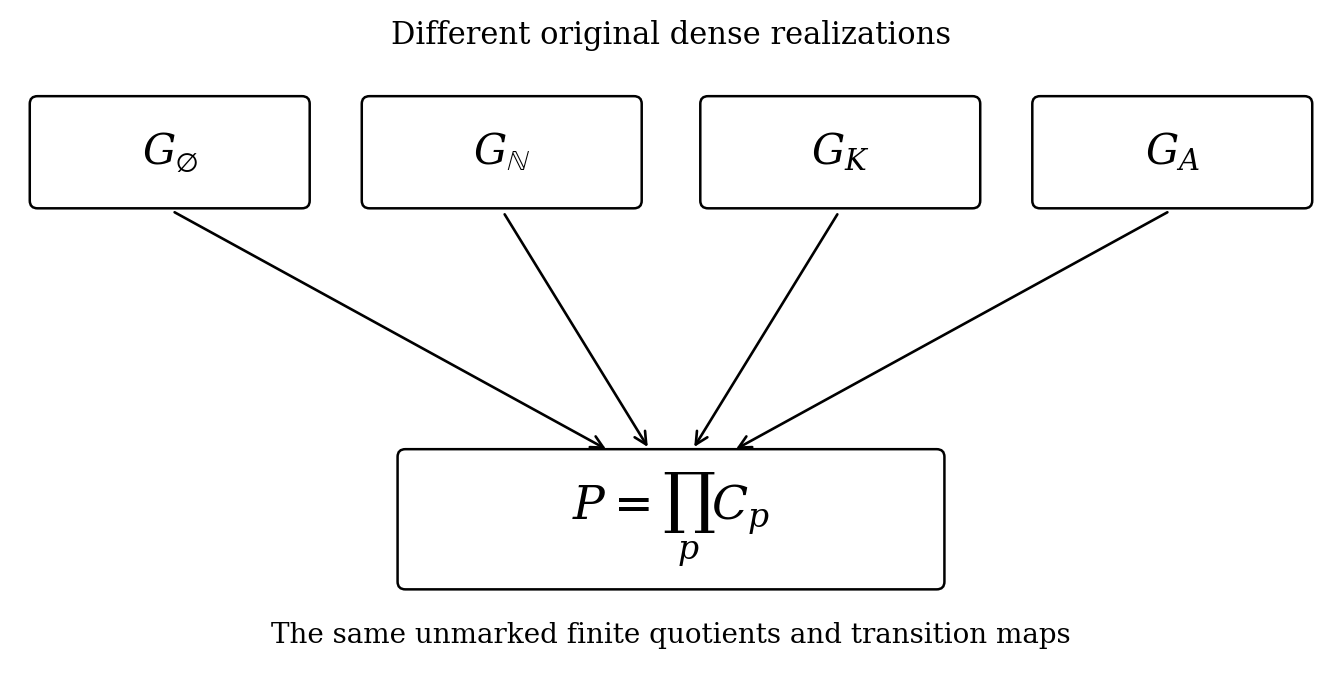
Let \({\mathcal F}(G)\) denote the unmarked inverse system of finite quotient groups and their transition maps, considered up to isomorphism as a pro-object. The source group \(G\) is not supplied again as part of the input. Nor do we retain evaluations of named source elements. Supplying the source itself would make a reconstruction problem vacuous, and supplying coherent marked elements is a stronger contract.
For the family of this book, there is no ambiguity about the comparison of pro-objects. The same concrete finite products
with the same coordinate projections form a cofinal model for every \({\mathcal F}(G_A)\). Proposition 4.5 also identifies the homomorphism sets into every finite target by a natural bijection induced by restriction to \(D\).
Theorem 9.1: No decoder from the unmarked finite-quotient system
There is no isomorphism-invariant assignment \(R\) on these observation systems such that
This remains impossible without any computability restriction on \(R\).
Proof
Take \(A=\varnothing\) and \(B={\mathbb N}\). Their observation systems are isomorphic by Theorem 6.3. Their selectors differ infinitely, so their groups are not isomorphic by Theorem 7.2. An isomorphism-invariant assignment has one output isomorphism type on that input observation type. It cannot recover both nonisomorphic source types.
The proof uses two objects, not a counting argument. The full family shows that the ambiguity is much larger: one observation system supports continuum many isomorphism types, including examples with every possible least presentation degree.
9.2 Element separation does not identify the source
On this page · Permalink · Source line 34
Every \(G_A\) is residually finite. Its coordinate maps distinguish any two distinct elements. They give an injective map
There is no conflict with Theorem 9.1. The injective map identifies each element once the domain is known. The unmarked inverse system does not identify the image of that domain among all compatible tuples.
The complete product is uncountable. Each \(G_A\) is countable and dense, hence proper and noncomplete. In particular, a theorem asserting that a complete compatible realization equals its inverse limit has not failed. These examples deliberately retain a different admissible subspace before completion.
Proposition 9.2: A proper map invisible after completion
The inclusion \(D\hookrightarrow G_A\) is not an isomorphism, but it induces an isomorphism of profinite completions.
Proof
The quotient \(G_A/D\cong{\mathbb Q}\) is nonzero, so the inclusion is proper. Both completions are canonically \(P\), and the coordinate inclusions agree, so the induced completion map is the identity on \(P\).
This supplies a map-level failure: completion need not reflect isomorphisms. It is stronger than merely exhibiting two abstract groups with isomorphic completions.
9.3 Faithful on maps, but not a full reconstruction
On this page · Permalink · Source line 52
There is a useful categorical distinction. A functor is faithful when different maps remain different. This does not require different objects to remain nonisomorphic, and it does not require every map between observed objects to lift.
Proposition 9.3: Faithfulness and failure of fullness
Profinite completion is faithful on the category of residually finite groups and group homomorphisms. Its restriction to the full subcategory with objects \(G_A\) is not full. On the larger full subcategory with objects \(D\) and all \(G_A\), it does not reflect isomorphisms.
Proof
Let \(f,g:H\to K\) be distinct homomorphisms between residually finite groups. Choose \(h\) with \(f(h)\ne g(h)\). Some finite quotient of \(K\) distinguishes those elements. Therefore the induced completion maps differ on the image of \(h\), proving faithfulness.
For failure of fullness, choose \(A{\ne^{*}} B\). Under the canonical identifications of the completions with \(P\), consider the identity map \(P\to P\). If it were induced by a homomorphism \(G_A\to G_B\), that homomorphism would be the identity on every coordinate and hence would include \(G_A\) into \(G_B\). Theorem 7.6 excludes such an embedding. After adjoining \(D\) to the source category, the proper inclusion of Proposition 9.2 proves failure to reflect isomorphisms.
The functorial extension of a homomorphism to profinite completions is standard [5], Proposition 3.1.2. The distinction between the two source categories is essential. Within the paired-prime family alone, a supplied map can be recovered more strongly.
Proposition 9.4: Reflection within the paired-prime family
For a homomorphism \(f:G_A\to G_B\), the induced completion map \(\widehat f\) is an isomorphism if and only if \(f\) is an isomorphism.
Proof
One implication follows from functoriality. Conversely, suppose \(\widehat f\) is an isomorphism. By Theorem 7.5, its coordinate action is multiplication by a diagonal sequence \(\lambda\). Each \(\lambda_p\) must be nonzero, so \(f\) is injective. If \(A{\ne^{*}} B\), Theorem 7.6 would force its image to be torsion, contradicting injectivity on an infinite-order element. Hence \(A{=^{*}} B\), and the source and target are equal as subgroups of \(P\). The map is now an endomorphism of that group with every diagonal entry nonzero. Corollary 7.8 makes it an automorphism.
Thus completion forgets distinctions between the objects \(G_A\), and some maps between their completions have no lift. But when a homomorphism between two members of this family is already supplied, an isomorphism after completion certifies that the supplied map was an isomorphism. This does not reconstruct an unknown source from its completion alone.
9.4 What a marked coherent point restores
On this page · Permalink · Source line 75
The coherent image of \(u_A\) in the finite quotients records, at prime \(p\), whether its coordinate is zero or one. Within the declared family, these zero patterns recover \(S_A\) and therefore \(A\).
This observation should be read in two directions. A marked coherent point can restore information discarded by the unmarked system. But specifying that infinite coherent point can itself require a noncomputable selector. The finite quotient tables remain computable while the chosen point does not.
One point is sufficient to identify our family because the construction contract says that the rational line through its tail class is the admissible quotient. Without that contract, a point in \(P\) would not identify an arbitrary dense subgroup containing it. The realization rule and its parameter must be retained together.
9.5 Two different inverse-limit assertions
On this page · Permalink · Source line 82
For the subgroup family \(D_B\), a complete coherent sequence of finite membership decisions determines \(B\) exactly. For the family \(G_A\), the unmarked finite quotient system is independent of \(A\). These are different observations, even though both involve finite structures and inverse limits.
The first system remembers which coordinate factors were selected. The second remembers the finite quotient objects but forgets how a distinguished infinite-order source element sits in them. Treating these as the same notion of “all finite information” would erase the very distinction that the construction proves.
The central idea
Reconstruction boundary. Compatibility identifies the complete ambient object. Reconstruction of a specified noncomplete source additionally requires its admissible image. A finite or effective realization must account for the information in that image.