Proof Path TheoryReading edition

Verification bandwidth and audit queues

Reading tools
Reading libraryFind statementsInspect Lean
Switch work

Saved reading

Read side by side

Start reading

Resources & source

Read and explore

Proofs and implementation

About this work

Other resources

Original TeX with line links · Download TeX

The wording and mathematics follow the retained manuscript. This reading format does not add a proof review or extend Lean coverage.

Skip contents and start reading

22 Verification bandwidth and audit queues

Let \(a_t\geq0\) be candidate arrivals during audit cycle \(t\), let \(s_t\geq0\) be service capacity, and let \(B_t\geq0\) be the unresolved backlog. Suppose arrivals in a cycle are available to that cycle's service. The basic deterministic queue is

\[ B_{t+1}=\max\{0,B_t+a_t-s_t\}. \]

Theorem 22.1: Constant-rate audit regimes

Suppose \(a_t\equiv\lambda\) and \(s_t\equiv\mu\).

  1. If \(\lambda<\mu\), every finite initial backlog reaches zero after finitely many cycles.

  2. If \(\lambda=\mu\), the backlog remains constant.

  3. If \(\lambda>\mu\), the backlog grows linearly with slope \(\lambda-\mu\).

Proof

Before the truncation at zero, each cycle adds \(\lambda-\mu\). When this quantity is negative, the backlog decreases by a fixed amount until it reaches zero. When it is zero, the backlog is unchanged. When it is positive, the truncation is never active after a nonnegative start, and the backlog is \(B_0+t(\lambda-\mu)\).
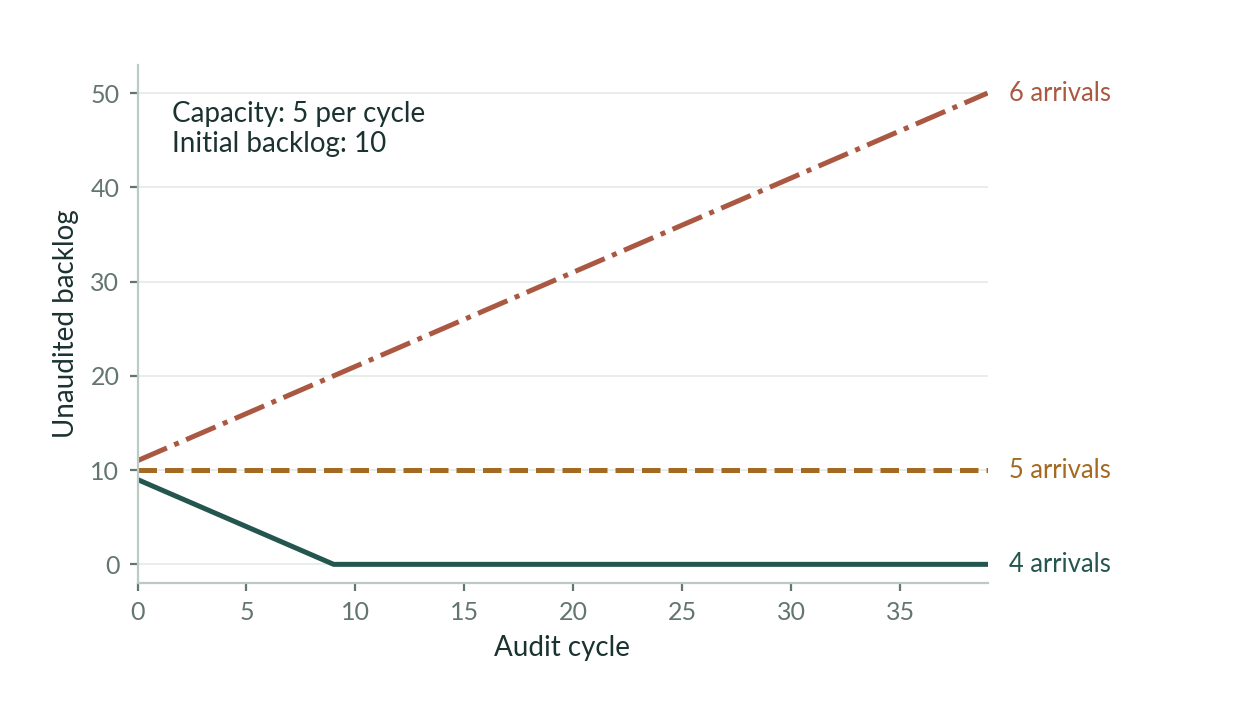
The committed audit example starts with backlog ten and capacity five. Four arrivals per cycle clear the queue, five preserve the backlog, and six increase it. Direct labels replace a separate legend. These are exact trajectories for the declared constant-rate model.
Figure 23. The committed audit example starts with backlog ten and capacity five. Four arrivals per cycle clear the queue, five preserve the backlog, and six increase it. Direct labels replace a separate legend. These are exact trajectories for the declared constant-rate model.

View full-size figure (new tab)

A simple audit priority score is

\[ P(x) = \frac{p_{\mathrm{err}}(x)\,c_{\mathrm{consequence}}(x) \bigl(1+r_{\mathrm{dependency}}(x)\bigr)} {c_{\mathrm{audit}}(x)}. \]

Here \(p_{\mathrm{err}}(x)\in[0,1]\), the consequence and dependency factors are nonnegative, and \(c_{\mathrm{audit}}(x)>0\). Zero-cost checks can be handled separately. This is a declared priority heuristic, not a probability of truth or a proved optimal scheduling rule.

Source and conversion record

Source SHA-256: ce05e88b439e9fd55ef6eb04da708a63ce02e6627424e6daac0dca4177b8ab51

Unsupported prose commands stop the build. The mathematical expression sequence is checked against the source, with manuscript macros expanded for display.

Conversion records

Notation in Proof Path Theory

Look up a symbol without leaving this chapter. Select text before opening help to search for it.

Search this work’s notation.

    Symbols can have different meanings in different passages. Read each result in its own context.

    Open the full notation index