Proof Path TheoryReading edition

Proof fields and certificates

Reading tools
Reading libraryFind statementsInspect Lean
Switch work

Saved reading

Read side by side

Start reading

Resources & source

Read and explore

Proofs and implementation

About this work

Other resources

Original TeX with line links · Download TeX

The wording and mathematics follow the retained manuscript. This reading format does not add a proof review or extend Lean coverage.

Skip contents and start reading

Part I Proof fields and certificates

A completed proof occupies only part of its surrounding field. Keep the successful deduction, but do not confuse its unused alternatives with either errors in that deduction or proofs of impossibility.
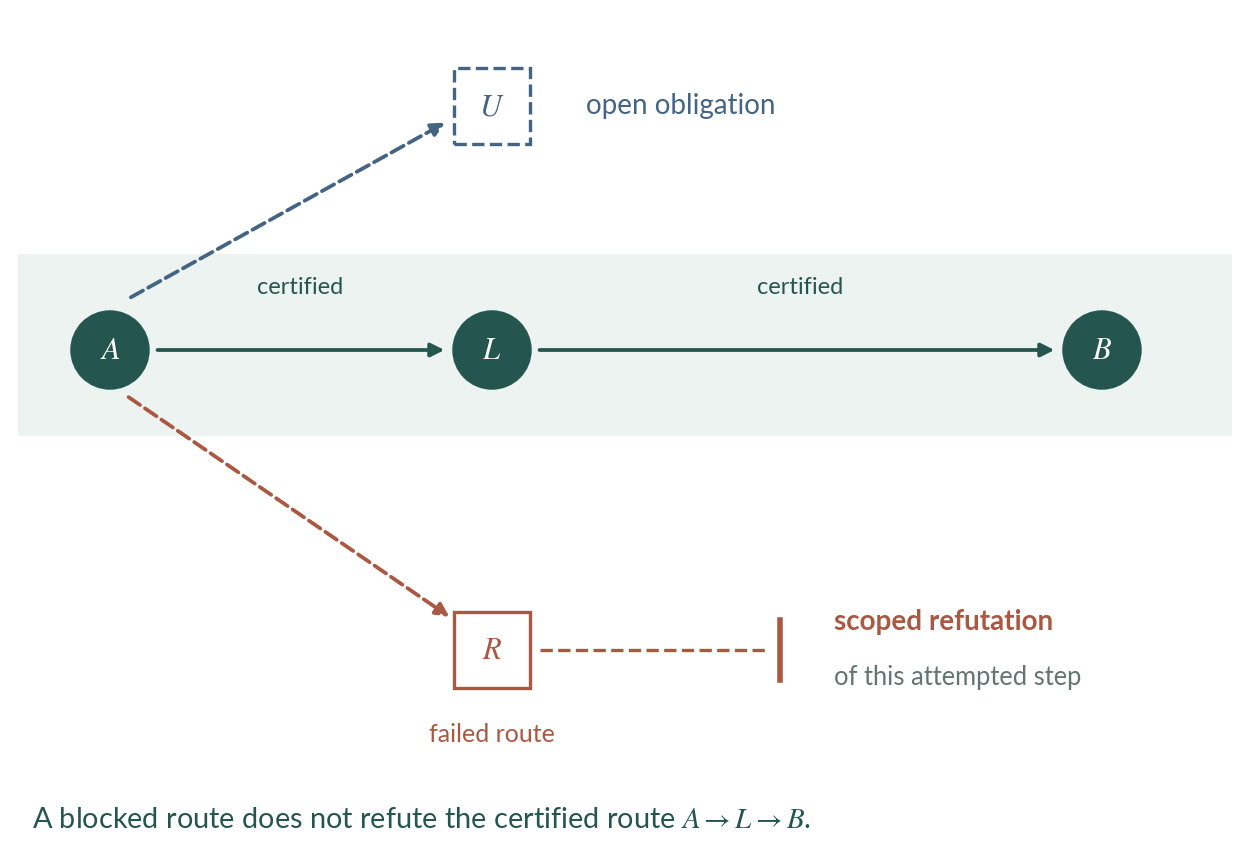
A declared proof field retains three different statuses. The solid route certifies the target. The upper branch has an unresolved obligation. The lower branch has a scoped refutation. Neither the open branch nor the refuted step invalidates the certified route.
Figure 2. A declared proof field retains three different statuses. The solid route certifies the target. The upper branch has an unresolved obligation. The lower branch has a scoped refutation. Neither the open branch nor the refuted step invalidates the certified route.

View full-size figure (new tab)

The governing distinction

A proof field preserves more than a proof needs. Its failed and unresolved records remain available to inquiry without acquiring the force of certified deductions.

Source and conversion record

Source SHA-256: ce05e88b439e9fd55ef6eb04da708a63ce02e6627424e6daac0dca4177b8ab51

Unsupported prose commands stop the build. The mathematical expression sequence is checked against the source, with manuscript macros expanded for display.

Conversion records

Notation in Proof Path Theory

Look up a symbol without leaving this chapter. Select text before opening help to search for it.

Search this work’s notation.

    Symbols can have different meanings in different passages. Read each result in its own context.

    Open the full notation index