
1 Introduction
On this page · Permalink · Source line 229
A published proof often presents an argument after its exploratory work has been compressed. Definitions have stabilized, unsuccessful approaches have been set aside, and a long calculation may now appear as a lemma. The change of representation that first made the argument visible can disappear into a single sentence. Such compression is often useful: it leaves a certificate that is easier to check and reuse.
Compression can also remove mathematical information that is not needed for the present theorem. An example may explain why a definition was chosen. A failed route may isolate the exact boundary of a method. An alternative proof may carry a bridge to another field. A computation may reveal a stronger statement than the one originally sought. None of these objects is automatically part of the final implication
They may still be part of the mathematical event that produced it.
Proof Path Theory studies this larger object without changing the standard of proof. Its central separation is
The certificate answers whether the conclusion follows. The discovery field records how the conclusion became reachable, what alternatives were considered, what was lost during compression, and which omitted structures may matter later.
The construction begins with a typed field of claims, justifications, evidence, and targets. Its certified rules determine which targets are derivable. A certificate selects enough of those records to support a declared conclusion, while the ambient field can retain unresolved or refuted alternatives.
A second layer asks what survives when the field is compressed. The answer depends on the questions that a representation must support. An archive intended for future discovery may preserve examples and failed approaches that a verification certificate can omit. A bridge graph makes one such retention problem precise.
The final layer concerns the continuing life of the archive. Revisions change the set of claims that need review. Shared errors affect the information supplied by multiple reviewers. Audit capacity limits how quickly new candidates can be checked. These models are connected by their declared proof objects, without treating social judgments as substitutes for deduction.
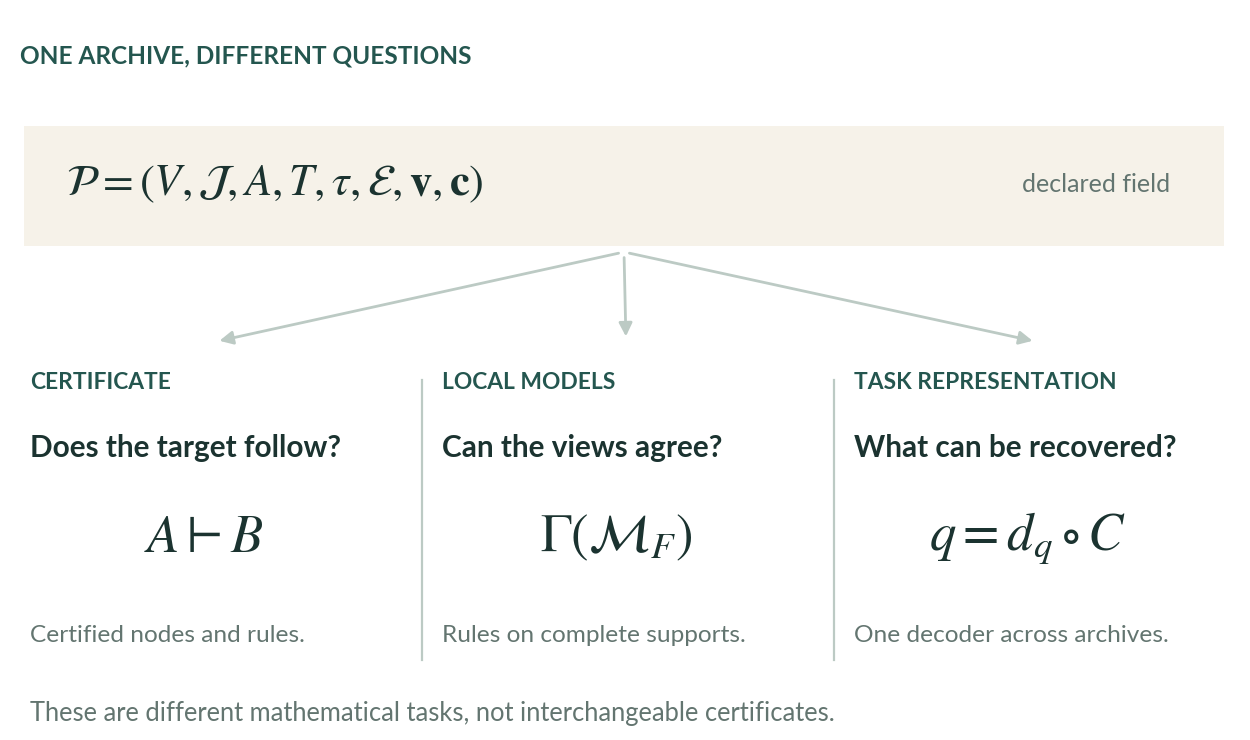
Komorebi Space enters when local descriptions of a proof field must agree. The construction of local rule models supplies actual restriction maps, not merely a visual analogy between two graphs. A gluing theorem identifies a sufficient condition for assembling those models, and a counterexample explains why pairwise dependency checks can miss a conjunctive rule. In a separate linear setting, the size of a realization fiber measures exactly what a new observation distinguishes.
The implemented proof fields are finite and acyclic. Some structural statements, including rule soundness and the linear separation alternative, are given in greater generality where their hypotheses allow it. Extensions to infinite search, probabilistic inference, and higher categorical proof objects require their own assumptions. Background on formal proof systems may be found in [2], [9].