
12 Vector-valued loss
On this page · Permalink · Source line 1474
Let a node \(v\) carry finite nonnegative numerical coordinates
representing declared verification, discovery, meaning, future bridge, and auditability weights. Summation requires an additive numerical model. The weights may be supplied or estimated, but an ordinal ranking alone does not justify adding them. Changing a numerical scale can change the resulting loss and retention problem.
Definition 12.1: Additive loss vector
For a retained node set \(K\subseteq V\), define
Normalize a coordinate by its total only when that total is positive. If the total is zero, nonnegativity makes every contribution in that coordinate zero. The implementation records normalized loss zero there as a convention, rather than dividing by zero.
Proposition 12.2: Zero verification loss can coexist with positive discovery loss
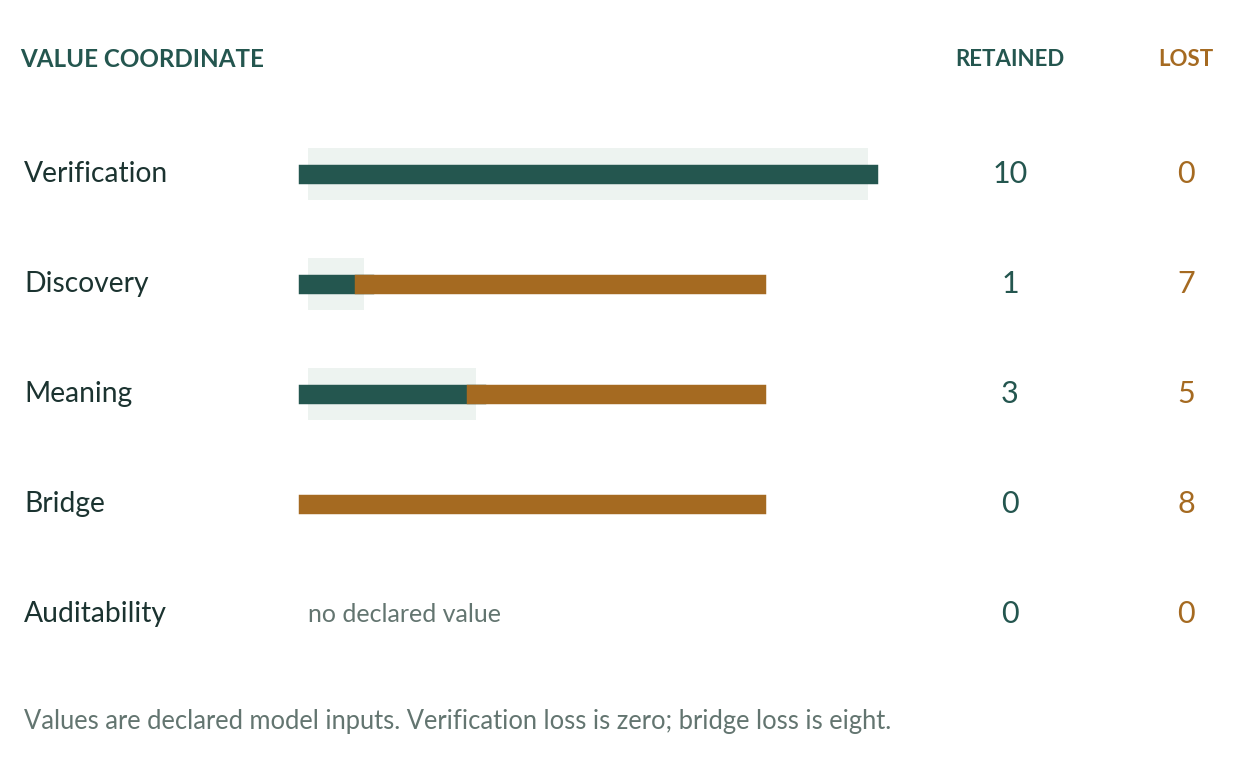
There exist proof fields and certificates \(K\) for which the verification coordinate of \({\operatorname{Loss}}({\mathcal P},K)\) is zero while the discovery and bridge coordinates are positive.
Proof
Take an AND-DAG certificate from \(A\) to \(B\) and add an optional example node \(E\) that is not an ancestor of \(B\). Assign positive discovery and bridge values to \(E\) and zero verification value. The unique core omits \(E\) while preserving the entire verification ancestry. The verification loss is zero and the other declared losses are positive.
No claim is made that all value coordinates are additive. Additivity is a transparent baseline. Interactions can be represented by hyperedge values, submodular utilities, or task-specific decoders when the application requires them.