
10 Accuracy-driven certification
On this page · Permalink · Source line 1
A requested tolerance is an input to the problem, not an informal expectation about its answer. The controller accepts a result only when an outward probability interval proves the multiplicative accuracy requirement. Failure to prove that inequality remains a failure of certification, even when a point estimate appears accurate.
The external numerical contract specifies the desired accuracy, not the internal transform resolution.
For an exact positive spectrum and threshold \(q\), the solver accepts a requested relative multiplicative accuracy
and returns a certified interval
only when
In logarithmic coordinates, if
the acceptance rule is
No value of \(N\), support width, or arithmetic precision appears in the external contract.
Theorem 10.1: Accuracy contract for the positive exact-spectrum backend
Assume an exact supplied positive decimal spectrum of rank greater than two, a threshold \(q\ge0\) with valid interval-design parameters, and requested multiplicative tolerance \(\varepsilon_{\rm req}>0\). Suppose the directed-rounding interval backend returns an enclosure
that includes the proved support/alias and omitted-mode remainders. If the accuracy-driven controller returns certified=True, then
and
If the resource caps are reached before this inequality is proved, the controller returns certified=False rather than promoting the interval midpoint to a certified answer.
Proof
The directed-rounding backend encloses the finite transform and exponential prefactor and then enlarges that enclosure by the proved support/alias and infinite-mode error bounds. Therefore the true tail probability lies inside the returned interval. The controller encloses \(\operatorname{expm1}(\log(10)(d_+-d_-))\) by directed rounding and sets certified=True only when the upper endpoint of that ratio enclosure is no larger than the lower endpoint of the exact requested tolerance enclosure. High precision alone is not an enclosure proof. The fail-closed branch follows directly from the controller definition.
10.1 Adaptive refinement
On this page · Permalink · Source line 86
The controller adjusts three internal resources:
the COS mode count \(N\).
the tilted support scale \(L\), which changes \(b\) and its associated Chernoff parameter.
the interval arithmetic precision.
At each stage the full directed-rounding interval is recomputed. If the rounding component is material relative to the requested budget, arithmetic precision is increased. Otherwise the dominant analytic contribution determines the next refinement: mode error increases \(N\), while support/alias error increases \(L\).
A certified return occurs only after the multiplicative inequality above has been proved. Reaching a resource limit instead terminates the calculation with the failure status described next.
10.2 Fail-closed behavior
On this page · Permalink · Source line 107
If the configured resource caps are exhausted before the requested accuracy is established, the solver does not silently return its midpoint as though it were certified.
Instead it returns
together with the unresolved interval and a failure reason.
This behavior is part of the numerical definition of the solver.
10.3 Accuracy ladder through \(10^{-5000}\)
On this page · Permalink · Source line 121
The exact control
was evaluated at tail depths
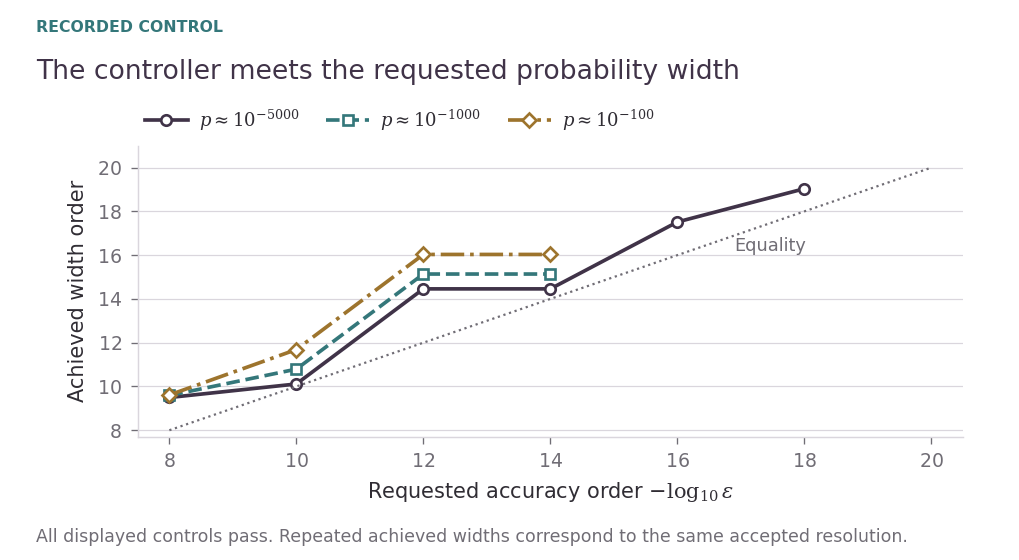
For each depth the controller was asked to prove relative multiplicative accuracies
All twelve contracts were satisfied.
At the \(10^{-5000}\) point, the controller produced:
| requested accuracy | achieved ratio minus one | \(N\) | \(L\) |
|---|---|---|---|
| \(10^{-8}\) | \(3.19\times10^{-10}\) | 64 | 10 |
| \(10^{-10}\) | \(7.70\times10^{-11}\) | 128 | 10 |
| \(10^{-12}\) | \(3.48\times10^{-15}\) | 128 | 12 |
| \(10^{-14}\) | \(3.48\times10^{-15}\) | 128 | 12 |
The gap between requested and achieved accuracy is expected: refinement is discrete, so one additional support or mode refinement can improve the certificate by several orders of magnitude.
A further stress test requested
relative accuracy at the same \(10^{-5000}\) tail. The solver obtained approximately
and
respectively.
10.4 Acceptance arithmetic and serialization are directed
On this page · Permalink · Source line 192
The acceptance condition must be evaluated as carefully as the probability interval.
Converting a tiny log-width \(w\) using
under an insufficient point-precision context can lose the width. At approximately \(10^{-15}\) relative scales, the ratio can round to zero.
Even when the probability interval remains valid, that conversion cannot support a certification decision. The implementation encloses
with directed interval arithmetic before deciding whether the requested accuracy has been met. Acceptance compares the upper endpoint of that ratio with the lower endpoint of the requested exact tolerance, so a rounded point estimate cannot promote an unresolved boundary case to success.
Authoritative output strings must preserve the same outer enclosure. The implementation converts each exact binary interval endpoint to a decimal string with Decimal and explicit ROUND_FLOOR for lower endpoints or ROUND_CEILING for upper endpoints. Ordinary interval display formatting is not used as an authoritative serialization method: nearest-rounded decimal text can move an endpoint inward even when the internal interval arithmetic was directed. Matrix-to-tail propagation keeps these endpoint strings and applies the same directed ratio test.
The correctness requirement applies not only to the tail integral but also to the logic that labels its result certified.
10.5 Input semantics at \(p\approx10^{-16}\)
On this page · Permalink · Source line 228
At this accuracy scale, the representation of the threshold \(q\) itself is measurable. In the \(0.02\chi^2_{80}\) control targeted at \(10^{-16}\), rounding the high-precision threshold to binary float64 shifts the exact tail by approximately
decades. The binary64 solver evaluated at that same rounded input then differs from the exact tail of the rounded input by approximately
decades.
Accordingly, claims below the float64 input-quantization scale use exact-decimal or interval inputs. The rigorous accuracy contract therefore certifies the mathematical inputs supplied to it, rather than silently identifying a rounded binary threshold with an ideal decimal threshold.