
3 Transformations must account for their remainder
On this page · Permalink · Source line 63
The easiest simplification is to keep what seems important and discard the rest. The difficulty is knowing whether the discarded information can influence a later question. A representation can be exact for one observation and fail under continuation. The failure is particularly clear in a small linear calculation.
Let \(P\) be a projector on a vector space, so \(P^2=P\), and put \(Q=I-P\). The image of \(P\) is the retained space. The image of \(Q\) is its complementary space. No inner product is required. If \(T\) is a linear operator, the compressed operator \(PTP\) records only the part that begins and ends in the retained space.
Insert \(I=P+Q\) between two applications of \(T\). Exact algebra gives
The second term has a plain meaning. The input leaves the retained space through \(QTP\) and later returns through \(PTQ\). Deleting that term is not a harmless change of notation. It changes the evolution unless a further condition makes the return vanish.
Work over \(\mathbb Q^3\), with
Here \(Tx=(4,6,-1)^{\mathsf T}\), so both descriptions give the retained observation \((4,6,0)^{\mathsf T}\). This agreement follows from \(Px=x\), not from closure under repetition.
After two steps the comparison changes:
The difference \(PTQTPx=(0,-1,0)^{\mathsf T}\) is the return of the discarded coordinate. Equation (1) predicted it.
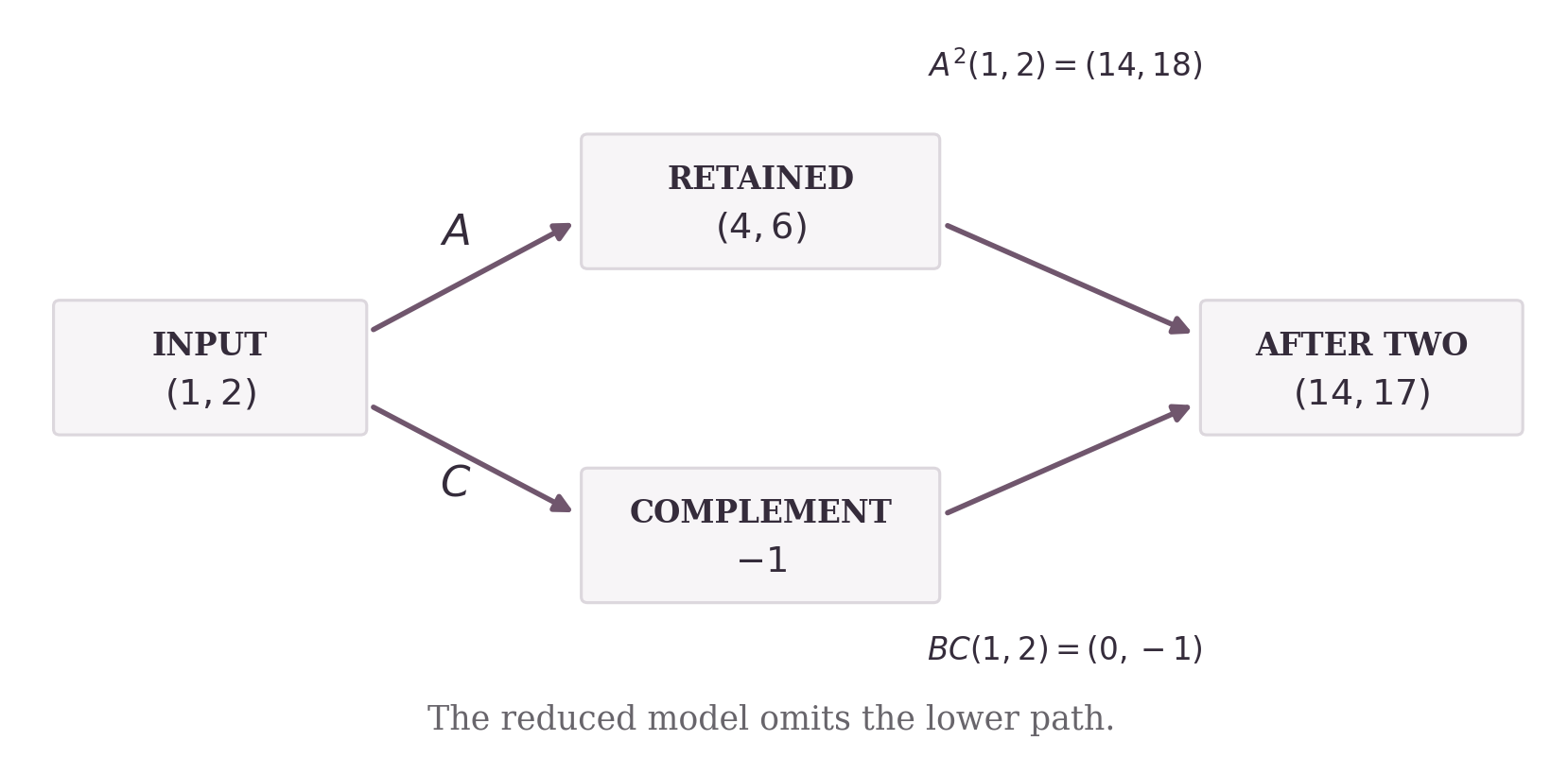
For the diagram, write \(T=\begin{psmallmatrix}A&B\\C&2\end{psmallmatrix}\) relative to the retained plane and its complement. Here \(A=\begin{psmallmatrix}2&1\\0&3\end{psmallmatrix}\), \(B=(0,1)^{\mathsf T}\), and \(C=(1,-1)\). The two paths contribute \(A^2(1,2)^{\mathsf T}\) and \(BC(1,2)^{\mathsf T}\) to their sum.
From a calculation to a reusable law
On this page · Permalink · Source line 100
The general packet formulation uses a finite family of pairwise annihilating projectors whose sum is the identity. Write \(T_{ij}=P_iTP_j\). Then
Composition follows paths through intermediate packets. The laws are familiar block algebra. Their methodological value is that they provide an exact interface for tracking what a decomposition retains and what it omits. Realization Calculus uses such interfaces to organize more specialized constructions without pretending that an arithmetic lane and an analytic subspace have identical additional properties.[1]
The example also suggests a better experiment. Merely repeating the first retained observation does not challenge the simplification. Continuing the system does. More generally, a test should be designed to expose the information a representation discards. That may mean increasing the number of compositions, changing a boundary condition, or testing a component that a cancellation had concealed.
Invariance supplies a sufficient answer in this setting. If \(QTP=0\), then \(T\) never sends a retained input into the complementary space, so the retained space is invariant and repeated restriction is exact. The condition is stronger than vanishing on one selected input. It is also stronger than the disappearance of one particular return term. A method that records the operator and its domain can distinguish these statements instead of treating them as interchangeable successes.
The missing coordinate becomes memory
On this page · Permalink · Source line 115
The discrepancy can do more than refute a simplification. It can tell us how to construct an exact replacement. Write a general block evolution as
where \(u_n\) is retained and \(v_n\) is complementary. Suppose first that \(v_0=0\). Repeated substitution in the second equation gives
For \(n=0\) the sum is empty. The induction step multiplies the preceding sum by \(E\) and adds \(Cu_n\). Substituting into the first equation therefore proves, for every \(n\geq0\),
The reduced description is exact, but it now carries memory. In the displayed rational example \(E=2\), and the first correction is \(BCu_0=(0,-1)^{\mathsf T}\). Equation (2) gives the correct second observation and governs every later step. This is a deduction from the block equations, not a fitted correction to a single failed experiment.
The requirement \(v_0=0\) is substantive. With a nonzero initial complementary state, the formula for \(v_n\) contains the additional term \(E^nv_0\), and the retained evolution contains \(BE^nv_0\). An unknown \(v_0\) cannot simply be erased. Either the problem supplies it, the retained data determine its relevant effect, or the prediction must preserve the remaining ambiguity.
The example now contains a complete research cycle. A proposed simplification fails. A transfer identity isolates the cause. Eliminating the hidden coordinate constructs a replacement. Induction proves the replacement for all times under stated initial data. Exact calculations can then test its implementation. The resulting memory formula is a reusable piece of mathematics. It may cost more to store a history than a single state, so an exact realization is not automatically the cheapest one. What has been gained is a clear account of the choice.
Defects must be transported before they are combined
On this page · Permalink · Source line 136
A similar issue arises when comparing two sequences of transformations. Let \(T:X\to Y\) and \(S:Y\to Z\) be linear maps, with comparison maps \(p:X\to X_0\), \(q:Y\to Y_0\), and \(r:Z\to Z_0\). Suppose \(T_0:X_0\to Y_0\) and \(S_0:Y_0\to Z_0\) are the proposed reduced maps. Their defects are
Adding and subtracting \(S_0qT\) gives
One defect is evaluated after \(T\). The other is carried forward by \(S_0\). Only then do they have the common source and target needed for addition.
This is what it means for a calculus to constrain its user. The phrase “the errors add” is not enough. The maps determine how they add. In another setting subtraction may not be defined at all, and an appropriate comparison must replace this formula. The shared method is the discipline of specifying the comparison, not the indiscriminate use of linear notation.
Accounting for a remainder does not require retaining every detail forever. It requires a reason why a discarded detail is irrelevant to the protected task, or a certificate of the effect it may still have. Once that reason is explicit, simplification can become both more aggressive and more trustworthy. The next step is to ask whether an identified defect can actually be removed.